
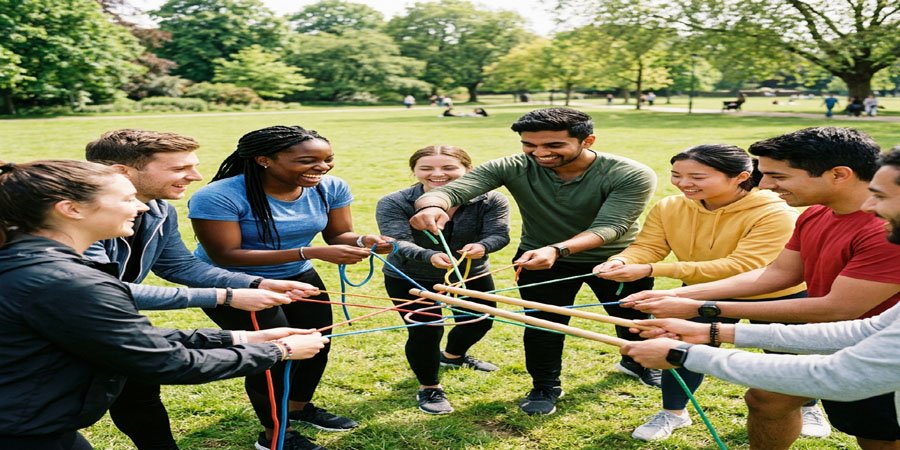
Are you in search of Youth Team Building Activities?
Young people learn best when they can move, talk, solve problems, and reflect together. Short shared tasks can build trust, improve listening, and help everyone feel included. These moments also give leaders a simple way to teach cooperation through action. When the activity is well planned, the lesson often sticks longer.
In this article, let’s see some Team Building Activities for Youth.
Here is an overview of the sections in this article:
- Key things to consider before leading these sessions.
- Ten practical exercises with steps, materials, timing, and debrief questions.
- Frequently Asked Questions.
So, let’s get started!
What Should You Consider Before Conducting These Activities?
Before you begin, keep these practical tips in mind to make each session smooth, safe, and useful.
Match the Activity to the Age Level
Choose tasks that fit the age, maturity, and attention span of your participants. Younger youth often need simple directions with movement. Older youth may enjoy deeper problem solving. A good fit keeps energy high, lowers confusion, and helps everyone join with confidence.
Keep Directions Short and Very Clear
Brief instructions save time and reduce mistakes during the activity. Explain the goal, basic rules, and time limit in simple words. If needed, show one quick example before starting. Clear direction helps participants focus on the challenge instead of asking repeated questions.
Plan for Safety and Space Needs
Check the room, field, or meeting area before you start. Remove hazards, mark boundaries, and make sure everyone can move safely. Choose materials that are easy to handle. A safe setup lets youth participate freely without stress, discomfort, or unnecessary risk.
Focus on Inclusion Over Competition
Some youth love competition, while others may feel pressure from it. Frame each task around shared success, listening, and support. Invite every voice into the process. When inclusion leads the activity, participants feel respected, valued, and more willing to contribute.
Leave Time for a Strong Debrief
The discussion after the task is where much of the learning happens. Ask open questions about choices, feelings, and lessons. Keep the tone curious, not judgmental. A short debrief helps youth connect the experience to real life situations.
10 Youth Team Building Activities
Here are some Youth Team Building Activities you can try.
#1. Human Knot Relay
This fast activity gets participants talking, moving, and solving a physical puzzle together. It works well as an icebreaker because it creates laughter while showing the value of patience and clear communication.
Time: 10-20 minutes
Materials: None
Participants: 3-8 people per group
Instructions
- Ask each group to stand in a circle, reach across, and hold two different hands from other people.
- Explain that the group must untangle the knot without letting go, unless safety becomes an issue.
- Encourage participants to slow down and speak clearly about each move, for example, stepping over linked arms one at a time.
- Stop when the circle is untangled or when the time limit ends, then move into reflection.
A Small Adjustment We Made While Conducting This Activity: We reminded participants to pause and identify possible moves before trying to untangle the knot. When several people attempted to move at once, the group became more tangled, so we encouraged them to work through one move at a time.
Debrief
- What helped your group stay calm when the puzzle felt difficult?
- How did people decide who would speak or move first?
- What does this activity show about solving problems with others?
You can also read:
10 Leadership Activities for Students (With Debrief)
#2. Silent Line Up
This exercise builds nonverbal communication and close observation in a simple way. Participants must cooperate without speaking, which often reveals new leadership habits and listening skills.
Time: 10-20 minutes
Materials: None
Participants: 3-8 people per group
Instructions
- Tell each group to line up in a specific order without speaking, such as by birthday month or shoe size.
- Set a clear time limit so participants must act with focus and urgency.
- Remind the group to use gestures, facial expressions, and movement, for instance, pointing to calendar months on fingers.
- Once each line is complete, ask members to say their answers aloud to check the order.
Debrief
- What forms of nonverbal communication worked best for your group?
- When did confusion happen, and how did you handle it?
- How can silent cooperation help in other settings?
#3. Cup Stack Challenge
This quick task asks participants to build a structure under simple limits. It encourages planning, role sharing, and careful trial and error.
Time: 10-20 minutes
Materials: Plastic Cups and Index Cards
Participants: 3-8 people per group
Instructions
- Give each group several cups with a few index cards, then explain the goal of building the tallest free-standing tower.
- Set a time limit and remind participants that the tower must stand on its own at the end.
- Ask the group to discuss a plan before building, for example, choosing whether to start with a wide base or a narrow one.
- Measure or compare the towers when time ends, then invite everyone to look at different designs.
Debrief
- What planning choices helped your group most?
- How did your ideas change once building began?
- What did this challenge teach about testing new ideas?
#4. Back-to-Back Drawing
This activity highlights the importance of clear instructions and active listening. One person describes an image while another tries to draw it without seeing the original.
Time: 10-20 minutes
Materials: Paper, Pens, and Simple Picture Cards
Participants: 4-8 people per group
Instructions
- Pair people within each group, then seat partners back to back so they cannot see each other’s papers.
- Give one person a simple picture card and ask that person to describe it without naming the object directly.
- Have the other person draw based only on the spoken directions, for instance, starting with a large square in the center.
- Compare the drawing with the original image when time ends, then switch roles if time allows.
Debrief
- What made some directions easier to follow than others?
- How did listening affect the final drawing?
- Where do you need this kind of communication in daily life?
#5. One-Word Story Circle
This speaking exercise helps participants practice focus, creativity, and shared ownership. Everyone must listen closely because each person adds only one word at a time.
Time: 10-20 minutes
Materials: None
Participants: 3-8 people per group
Instructions
- Ask each group to sit in a circle and explain that they will create one story using one word per person.
- Start with a simple opening word, then have the story move around the circle one participant at a time.
- Encourage the group to keep the story clear and connected, for example, by listening for the main setting or problem.
- End after a set number of rounds, then invite volunteers to retell the final story aloud.
Debrief
- What helped your group keep the story moving smoothly?
- How did you respond when the story went in an unexpected direction?
- What does this show about building on other people’s ideas?
#6. Minefield Walk
This trust-based task asks one participant to move through obstacles while guided by others. It builds careful listening, support, and responsibility in a memorable way.
Time: 10-20 minutes
Materials: Cones, Chairs, and Blindfolds
Participants: 3-8 people per group
Instructions
- Set up a simple obstacle path for each group using cones or chairs with enough room for safe movement.
- Blindfold one participant while the rest of the group gives verbal directions to guide that person through the path.
- Remind the group to use calm, specific language, for instance, saying “two small steps left” instead of “go that way.”
- Rotate roles so several participants get a chance to guide or walk before ending the activity.
Debrief
- How did trust affect the way your group communicated?
- What kind of directions were most helpful during the walk?
- How can clear guidance improve confidence in real situations?
#7. Common Ground Countdown
This activity helps participants discover shared interests in a fun, fast format. It can deepen connection because youth often realize they have more in common than expected.
Time: 10-20 minutes
Materials: Timer
Participants: 3-8 people per group
Instructions
- Tell each group they have a short time to find a set number of things that every person has in common.
- Make clear that shared items should be specific and meaningful, not too obvious.
- Encourage the group to ask focused questions, for example, about hobbies, favorite foods, or places they have visited.
- When time ends, have each group share a few examples with everyone else.
Our Experience While Conducting This Activity: Some groups quickly identified obvious similarities, such as favorite foods, but took longer to find less common interests. We asked them to move beyond basic preferences and share more specific experiences when searching for common ground.
Debrief
- Which shared points surprised your group most?
- How did this activity change the way you see one another?
- Why does finding common ground matter in a new setting?
#8. Marshmallow Balance Build
This challenge invites participants to create a standing structure with limited supplies. It teaches planning, balance, and the need to adjust quickly when a design fails.
Time: 10-20 minutes
Materials: Marshmallows, Toothpicks, and Paper Plates
Participants: 3-8 people per group
Instructions
- Give each group marshmallows and toothpicks, then explain that they must build the tallest structure on a paper plate.
- Set a short time limit so participants need to organize their ideas quickly.
- Suggest that the group test balance during the build, for example, pressing gently on the base before adding height.
- Stop at the end of the round and compare which structures stayed standing without support.
Debrief
- What design choices made your structure stronger?
- How did your group react when something collapsed?
- What can this activity teach about persistence?
#9. Puzzle Piece Swap
This cooperative game asks participants to complete a puzzle while some needed pieces start with other people. It promotes negotiation, sharing, and awareness of the larger goal.
Time: 10-20 minutes
Materials: Simple Puzzles and Envelopes
Participants: 3-8 people per group
Instructions
- Prepare puzzle pieces in envelopes so each group starts with some pieces that belong to another set.
- Tell the groups that the goal is for everyone to complete a puzzle, not just finish their own first.
- Allow participants to talk, trade, and problem solve, for example, offering a needed corner piece in exchange for a border piece.
- End when puzzles are complete or time runs out, then discuss how people made decisions.
Debrief
- How did your group balance self-interest with shared success?
- What made trading easy or difficult?
- When do you face similar choices outside this activity?
#10. Fast Facts Circle Toss
This simple game combines movement with quick sharing to help participants learn about one another. It works well at the start of a program because it is easy to run and highly engaging.
Time: 10-20 minutes
Materials: Soft Ball
Participants: 3-8 people per group
Instructions
- Ask each group to stand in a circle with one soft ball.
- Explain that the person holding the ball shares one fact, then tosses it to someone new across the circle.
- Add a second round with a prompt, for instance, “share a skill you want to improve” or “name a place you enjoy.”
- Continue until everyone has shared several times, then close with a quick summary of what people learned.
What We Learned While Conducting This Activity: During the first round, participants tended to share simple facts about themselves, while the second prompt produced more detailed answers about skills and interests. We noticed that the choice of prompt made a clear difference in the kinds of responses people shared.
Debrief
- What new facts helped your group connect more quickly?
- How did the movement affect energy and attention?
- What kinds of sharing prompts led to the best conversation?
Want to Develop Leaders at Every Level of Your Organization?
Equip your employees with the leadership skills, qualities, and mindset they need to take on greater responsibilities. Get my comprehensive guide and put our proprietary ZIGN Framework™ of Leadership into practice:
Looking for Unique Team Building Activities?
Help your employees build stronger relationships, improve collaboration, and progress through every stage of team development. Get my practical guide and put these activities into action:
Want to Make Your Company Culture Even Stronger?
Help your employees connect with your company’s mission, work toward its vision, and contribute to a positive workplace culture. Get 5 unique activities every month—with no trainer or preparation required.
Final Words
Youth team building activities can create strong learning moments when they are planned with care. The best results often come from clear instructions, active participation, and thoughtful reflection. These ideas can help youth practice trust, listening, creativity, and cooperation in a short time. You can use them in classrooms, camps, clubs, or leadership sessions. Pick one that fits your setting, then lead the debrief with purpose.
FAQ: Youth Team Building Activities
You might have these questions in mind.
How do I choose the right activity for my group?
Start by thinking about age, energy level, and available space. Then match the activity to your goal, such as trust, communication, or problem solving. Keep directions simple if your participants are new to structured exercises. A good match makes the session smoother and more meaningful.
How long should the debrief be after each activity?
A short debrief of three to five minutes often works well for these exercises. The goal is to help participants connect the task to real behavior. Ask open questions that explore feelings, choices, and lessons learned. Keep the tone supportive so youth feel safe sharing honest thoughts.
Can these activities work in a classroom setting?
Yes, many of these ideas fit classrooms with only small adjustments. Choose tasks with low noise, clear boundaries, and easy materials. You can also shorten the time if your schedule is tight. A strong setup helps students stay focused while still enjoying the process.
What if some participants do not want to join?
Start with low-pressure activities that feel safe and simple. Avoid forcing someone to speak first or take a high-risk role right away. Give clear encouragement, then offer supportive ways to join gradually. Many hesitant participants open up once they feel respected and included.
How can I make these activities more inclusive?
Use simple language, flexible roles, and accessible movement options when planning. Think ahead about physical needs, comfort levels, and different communication styles. You can adapt materials or rules so more people can take part fully. Inclusion improves both participation and learning for everyone.
Like this article on “10 Youth Team Building Activities”? Feel free to share your thoughts.
