
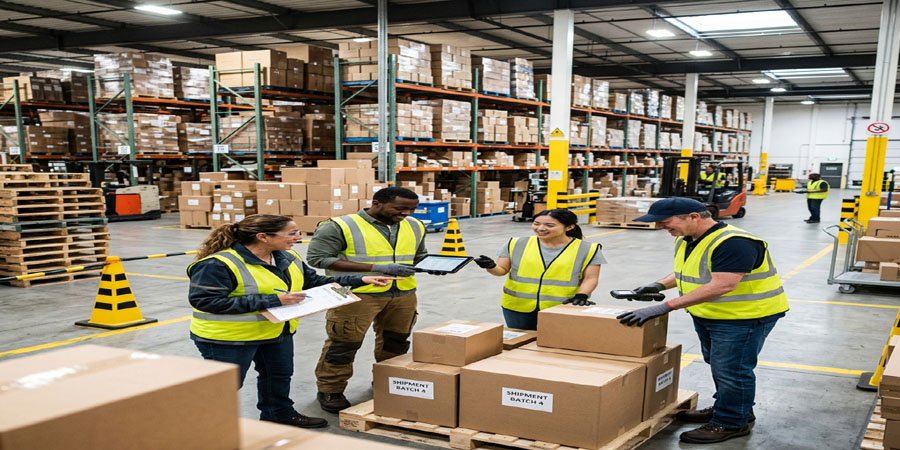
Are you in search of Warehouse Games?
These activities bring teams together to solve common challenges in a warehouse environment. Practical exercises build stronger communication and faster problem solving while keeping engagement high. Each challenge uses real tools and scenarios teams tackle every day. By practicing together, participants sharpen skills they rely on during their regular shifts.
In this article, let’s see some Warehouse Games for your teams.
Here is an overview of the sections in this article:
- What should you consider before conducting these activities?
- Ten fast exercises with materials, steps, and debrief prompts.
- Frequently Asked Questions.
So, let’s get started!
What Should You Consider Before Conducting These Activities?
Use these tips to make each session safe, smooth, and worth the time.
Check Safety Conditions First
Review the play area before starting any activity. Remove hazards, mark clear boundaries, and confirm walking paths. Make sure tools are safe for quick use. A short safety briefing helps everyone stay alert, follow rules, and enjoy the exercise with confidence.
Match the Activity to the Goal
Choose an exercise that supports a clear outcome. Some activities improve communication, while others build accuracy or speed. When the purpose is obvious, people engage more fully. A focused choice also makes debriefs easier because the learning point stays connected to daily work.
Keep Instructions Short and Clear
Give directions in plain language before the timer starts. Show one quick example if needed. Clear guidance reduces confusion, saves time, and keeps energy high. When people know the rules, they can focus on solving the task instead of guessing what happens next.
Use Materials that are Easy to Find
Pick simple items already available in most facilities. Cones, labels, clipboards, empty boxes, and markers often work well. Familiar objects reduce setup time. They also make the activity feel practical because participants can connect the exercise to their normal work environment.
Plan Time for Reflection
Do not end the session right after the task. Leave a few minutes for discussion about what worked, what failed, and what should change. Reflection turns movement into learning. It helps people connect the exercise to better habits, stronger communication, and smarter decisions.
10 Warehouse Games for Teams
Here are some Warehouse Games you can try with your teams.
#1. Pick Path Challenge
This activity tests route planning under light time pressure. It helps participants think about movement efficiency, communication, and accuracy during a simple picking simulation.
Time: 10-20 minutes
Materials: Clipboards, Pick Lists, Cones, and Empty Boxes
Participants: 3-8 people per group
Instructions
- Set up cones on the floor to mark different warehouse zones, then place empty boxes at each zone.
- Give every group a pick list that links item names to the boxes located in those warehouse zones.
- Direct each group to discuss and plan the quickest path to collect all items, such as beginning at the farthest zone first.
- Start the timer, then check after the run to confirm that teams have gathered exactly the boxes shown on their list.
Debrief
- What planning choices helped you move faster?
- Where did accuracy become harder to maintain?
- How could this activity connect to real picking tasks?
You can also read:
50 Awesome Team Building Activities (Workplace)
#2. Label Match Race
This exercise builds attention to detail through a fast sorting task. It encourages participants to slow down mentally even when the timer creates pressure.
Time: 10-20 minutes
Materials: Printed Labels, Marker Cards, Bins, and Stopwatch
Participants: 3-8 people per group
Instructions
- Set the bins on a table and clearly mark each one with a specific category or code.
- Place the printed labels face down, then instruct participants to flip over one label at a time on their turn.
- As each team member turns a label, have them quickly decide and place it into the bin that matches the label’s category—for example, matching aisle codes to their correct bin location.
- When time is up, count how many labels each team placed correctly and announce the team with the most accurate matches as the winner.
Debrief
- What methods helped your team stay accurate?
- When did speed begin to hurt decision quality?
- How can label checking improve daily warehouse work?
#3. Pallet Stack Planning
This activity focuses on organization before action. It shows how a short planning conversation can reduce wasted movement during physical tasks.
Time: 10-20 minutes
Materials: Empty Cartons, Tape Marks, and Task Cards
Participants: 3-8 people per group
Instructions
- Use tape to clearly mark a space on the floor for stacking, then give each group the correct number of empty cartons.
- Provide each group with a task card that details the stacking rule, such as by size, weight, or another order.
- Give groups one minute to talk through their stacking plan before touching any cartons.
- Start the timer and instruct groups to stack cartons following their plan; score finished stacks for stability, rule accuracy, and speed.
Debrief
- How did planning affect the final result?
- What would you change in your approach next time?
- Where do you see this kind of planning at work?
#4. Scanner Signal Relay
This quick relay highlights handoff clarity during a shared task. It helps participants practice clean communication when one missed detail can disrupt the whole process.
Time: 10-20 minutes
Materials: Barcode Cards, Clipboards, Pens, and Cones
Participants: 3-8 people per group
Instructions
- Place all barcode cards at one end of the play area and set a clipboard at the opposite end for writing down codes.
- The first participant looks at one barcode card, memorizes the code, and returns to tell it verbally to the next teammate.
- The next teammate writes down exactly what they hear—such as a specific number or location code—on the clipboard, then takes their turn memorizing and passing a new code.
- Continue until every card’s code is relayed and written, then compare the team’s written list with the original barcode cards to check for accuracy.
Debrief
- What made message handoffs easy or hard?
- How did your team handle unclear information?
- What workplace tasks require this same kind of precision?
#5. Packing Station Puzzle
This game combines sequencing with problem solving. It helps participants think through the right order of actions in a packing process.
Time: 10-20 minutes
Materials: Process Cards, Tape, Boxes, and Marker Pens
Participants: 3-8 people per group
Instructions
- Lay out all packing process cards on a table, mixing up their order so nothing is sequential.
- Instruct each group to arrange the cards in the exact order they believe matches a correct packing workflow, racing the clock.
- Once every group has finished, have them clearly explain their chosen sequence and their reasoning in front of everyone.
- Reveal the official packing process, compare it to each group’s sequence, and discuss any steps that were missing or misplaced.
Debrief
- Which step caused the most disagreement?
- How did your group decide on the final order?
- What does this reveal about process knowledge on the floor?
#6. Inventory Memory Run
This exercise strengthens recall under movement. It shows how memory, observation, and communication affect inventory-related tasks.
Time: 10-20 minutes
Materials: Item Cards, Tables, Covers, and Notepads
Participants: 3-8 people per group
Instructions
- Lay several item cards face-up on a table, giving participants exactly ten seconds to study all the card details before you cover them.
- After covering the cards, direct each team to write down every item detail they remember as quickly and clearly as possible.
- Encourage teams to include information such as item color, identifying code, quantity, or storage zone for each item.
- Uncover the cards and compare answers, scoring each team on the accuracy and completeness of what they recalled.
Debrief
- What memory strategies worked best for your team?
- Which details were easiest to forget?
- How can better observation support inventory accuracy?
#7. Dock Door Decision Drill
This activity develops quick judgment using simple shipping scenarios. It helps participants discuss priorities before taking action.
Time: 10-20 minutes
Materials: Scenario Cards, Whiteboard, Markers, and Timer
Participants: 3-8 people per group
Instructions
- Give each group one scenario card describing a dock issue, such as a late truck arrival or a mixed shipment that needs quick action.
- Ask every group to discuss and write down the first three steps they would take to handle the situation.
- Set a timer for decision-making, then have each group present their three steps and explain their reasoning to everyone.
- Emphasize if a group lists actions such as safety checks or communicating with the carrier, they should describe exactly how and when those steps would take place.
Debrief
- What influenced your first decision most?
- How did you balance speed with good judgment?
- What real dock situations could benefit from this practice?
#8. Accuracy Bucket Toss
This light physical activity reinforces focus through target-based scoring. It is simple to run, yet it opens a useful conversation about consistency and control.
Time: 10-20 minutes
Materials: Soft Balls, Buckets, Score Sheets, and Tape
Participants: 3-8 people per group
Instructions
- Arrange the buckets at set distances from the throwing line, and assign a clear point value to each bucket.
- Give each team a set number of soft balls and explain that all players must remain behind the marked stance line when throwing.
- Have players take turns tossing balls, aiming for the highest points while maintaining proper throwing form each time.
- Once all balls have been thrown, add up the total score for each team, then discuss whether more difficult shots led to less accuracy.
Debrief
- How did people choose between safe points and harder shots?
- When did focus matter more than speed?
- How does this relate to precision at work?
#9. Silent Sort Challenge
This activity trains nonverbal coordination in a fast sorting task. It reveals how much people rely on gestures, observation, and role awareness.
Time: 10-20 minutes
Materials: Colored Cards, Bins, Gloves, and Timer
Participants: 3-8 people per group
Instructions
- Spread the colored cards randomly across a table and set matching bins nearby, one for each color.
- Explain that everyone must sort cards into the correct bins without using words or sounds at any time.
- Participants use nonverbal communication, such as pointing, signaling, or making eye contact, to coordinate sorting decisions together.
- When all cards are sorted into bins, check the results as a group and discuss how quickly and accurately the sorting was finished.
Debrief
- What nonverbal methods helped most?
- Where did silence create confusion?
- How can clearer visual signals help in real tasks?
#10. Load Balance Build
This exercise highlights coordination during a shared building task. It encourages participants to test ideas quickly, then adjust based on results.
Time: 10-20 minutes
Materials: Empty Boxes, Bean Bags, Tape, and Rulers
Participants: 3-8 people per group
Instructions
- Instruct each team to use empty boxes and build a freestanding structure inside a clearly marked area on the floor.
- After teams finish building, place several bean bags on top of each structure to test how well it balances and supports weight.
- Allow teams to observe the results and make one change to improve stability, for example, widening the base or reinforcing the middle layer.
- Measure each structure’s height and stability, then check if it remains upright and inside the boundaries to assign a final score.
Debrief
- What design choices improved stability?
- How did your team respond after the first test?
- What does this teach about trial, feedback, and adjustment?
Want to Develop Leaders at Every Level of Your Organization?
If you want a practical system to develop leaders at all levels, get this master guide and apply our proprietary ZIGN Framework™ of Leadership:
Looking for Unique Team Building Activities?
If you want unique activities that help your workforce grow through every stage of team development, get this guide:
Need Fresh Team Building Activities Every Month?
If you are a busy leader, get 5 unique, fully customizable activities every month—no preparation or trainer required.
Final Words
Short activity sessions give teams fast ways to build better focus, communication, and problem solving. Simple games linked to daily habits deliver immediate, practical learning. Select one exercise that matches your current needs, then see how participants respond. Consistent use encourages progress and strengthens workplace connections. So, start now and observe positive changes over time.
FAQ: Warehouse Games
You might have these questions in mind.
Are these activities suitable for all warehouse roles?
Yes, most of these activities suit receiving, packing, picking, or shipping roles because the games fit across departments. You can adapt examples and materials to connect with each function, which keeps tasks relevant and engaging. A few simple tweaks make exercises practical, helping everyone see the value and apply lessons on the floor.
How often should we run these activities?
A short session once every week or two works well for most workplaces and keeps things fresh without interrupting daily tasks. You can run these on training days, during meetings, or as a shift handover. Consistency matters—set a schedule that fits your workflow so everyone gets an equal chance to participate.
How do we keep the activities safe?
Start by choosing an open area with safe walking paths and enough space between workstations or equipment. Use only light materials that won’t injure anyone if dropped. Explain boundaries before beginning and remind everyone to move carefully. A quick safety review before each session helps prevent accidents and sets the right tone for safe, fun learning.
What if some participants do not want to join?
Begin with low-pressure activities that are simple and useful, using clear communication about each session’s goal. Share the purpose so everyone sees the value right away. Offer small supporting roles to those hesitant to join. Encouragement, patience, and time for questions help most people gain confidence and participate over time.
Can these activities support training goals?
Yes, these activities help reinforce essential skills like communication, observation, sequencing, and decision-making in a practical setting. Tying debrief discussions to real tasks makes each lesson stick. Use one focused learning objective for each session. That way, everyone gets a clear, useful takeaway they can apply during warehouse work.
Like this article on “10 Warehouse Games for Teams”? Feel free to share your thoughts.
