
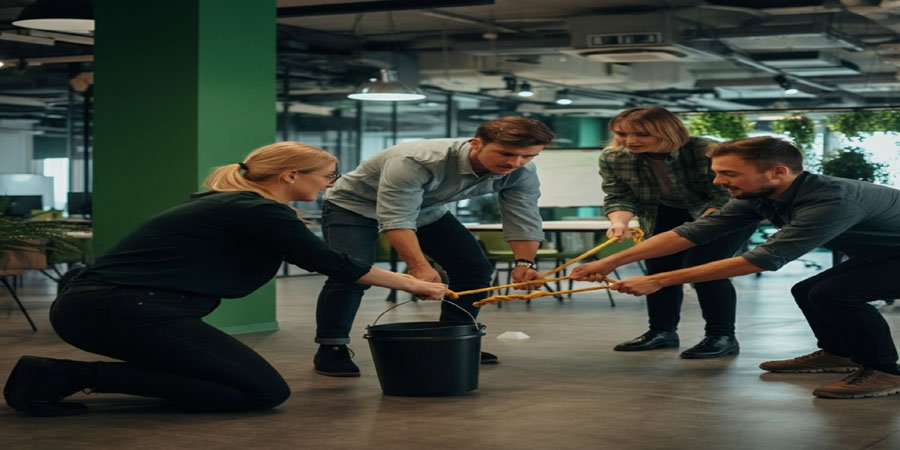
Do you want to conduct the Toxic Waste Activity with your teams?
This popular experiential learning exercise is rooted in sociotechnical systems theory, emphasizing the interplay between social interactions and technical tasks. It challenges groups to solve complex physical problems under constraints, mirroring workplace dynamics where resources are limited but stakes are high. By forcing participants to coordinate movement and communicate effectively without direct contact, the game highlights the necessity of shared mental models for success.
In this article, let’s see how you can facilitate this powerful exercise to transform group dynamics.
Here is an overview of the sections in this article:
- Objective of the toxic waste activity
- 5 variations of the activity
- Expert facilitation tips for maximum impact
- Frequently asked questions about the exercise
Objective of the Activity
The Toxic Waste challenge is designed to move beyond simple icebreakers into deep organizational learning. It serves as a microscopic simulation of project management, revealing how teams handle pressure, planning, and execution simultaneously.
Let’s look at the key objectives this activity aims to achieve.
Enhance Team Communication
The activity encourages team members to communicate clearly and effectively to achieve a shared goal. Participants must learn to share ideas, provide feedback, and listen actively under challenging conditions. This fosters an environment of open dialogue and mutual understanding.
Promote Strategic Planning
Teams must strategize before taking action, prioritizing steps and assigning roles to ensure efficiency. The challenge highlights the value of planning to avoid unnecessary mistakes. It underscores how proper preparation enables smoother execution.
Build Problem-Solving Skills
Unpredictable obstacles push participants to think critically and adapt quickly. Teams work together to analyze scenarios and come up with creative solutions. This reinforces the importance of collective problem-solving in achieving success under pressure.
Foster Collaboration and Trust
The challenge is structured to rely heavily on trust and collaboration. Team members must depend on each other’s strengths and work cohesively to overcome obstacles. This helps build stronger bonds and a deeper sense of camaraderie.
Manage Time and Resources Effectively
Participants are tasked with balancing limited resources and time efficiency to complete the activity. It showcases the importance of prioritizing tasks and minimizing waste. This teaches the critical skill of making the most out of available resources under tight deadlines.
5 Variations of the Toxic Waste Activity
Here are 5 variations of the Toxic Waste Activity designed to target specific team dynamics and challenges.
#1. The Classic Toxic Waste Transfer
This is the foundational version where teams must move a bucket of “toxic” balls to a safe zone using only ropes attached to a bungee cord. It focuses on pure coordination and basic communication skills within a standard timeframe.
Time: 10-20 minutes
Materials: 1 small bucket, balls (toxic waste), 1 bungee cord loop, and 4-8 ropes (5-7 ft each)
Participants: 3-8 people per group
Instructions
- Place the bucket full of balls in the center of a “radiation zone” marked by tape or cones (approx 8ft diameter).
- Ask each team to use the bungee cord and ropes to lift the bucket and transport it to a neutralization bucket placed 15-20 feet away.
- Tell participants they cannot cross into the radiation zone with any body part, nor can they touch the bucket directly.
- For example, if a participant steps over the line, the team must restart the entire process from the beginning.
Debrief
- How did your team decide on a strategy before touching the equipment?
- What was the most difficult part of coordinating the movement?
- How did the team handle frustration when the bucket wobbled?
You can also read:
50 Easy Team Building Activities (Workplace)
#2. The Silent Operator
This variation removes verbal communication to emphasize non-verbal cues and shared mental models. It highlights how much we rely on words and how often they can be inefficient or confusing.
Time: 10-20 minutes
Materials: Same materials as the classic version
Participants: 3-8 people per group
Instructions
- Explain the standard rules of moving the bucket, but introduce a strict “no talking” rule for the duration of the lift.
- Allow the team 5 minutes of planning time where they can talk, strategize, and practice hand signals before the silence begins.
- Start the timer and penalize any verbal sounds by sending the bucket back to the start.
- For instance, if someone gasps or shouts a warning, the team must pause for 30 seconds as a penalty.
Debrief
- How did the lack of verbal communication change your approach?
- What non-verbal signals proved to be the most effective?
- Did a leader emerge differently without the ability to speak? If so, why?
#3. The Blindfolded Guide
This version creates a high-dependency scenario where only one person can see, mimicking leadership structures where managers have the vision but workers execute the task. It tests trust and the clarity of instructions.
Time: 10-20 minutes
Materials: Classic kit plus blindfolds for all team members except one
Participants: 3-8 people per group
Instructions
- Select one person to be the “Leader” who stays outside the zone and can see, while all other rope holders are blindfolded.
- Direct the blindfolded members to pick up the ropes and wait for verbal instructions from the Leader to attach the bungee to the bucket.
- Require the Leader to guide the team safely to the neutralization zone using only their voice.
- For example, the Leader must give precise commands like “Person A, step left,” instead of vague directions like “move over there.”
Debrief
- How did it feel to be completely dependent on one person’s voice?
- What specific words helped you trust the Leader more?
- How did the Leader handle the pressure of being solely responsible for the vision?
#4. The Obstacle Course Run
This variation adds physical complexity to the transport phase, simulating a project environment that changes rapidly. It requires agility and the ability to adapt movement strategies on the fly.
Time: 10-20 minutes
Materials: Classic kit plus chairs, and cones, or boxes to create barriers
Participants: 3-8 people per group
Instructions
- Set up a path between the start and finish zones that includes obstacles they must navigate around or over.
- Instruct the team that the rope tension must remain constant while navigating these physical barriers.
- Introduce height requirements, such as lifting the bucket over a string tied between two chairs.
- For instance, the team might have to squat under a rope while keeping the bucket elevated to clear a hurdle.
Debrief
- How did the obstacles affect your team’s stability?
- Did you have to change your formation to navigate the barriers? If so, why?
- How did you communicate changes in terrain to the rest of the group?
#5. The Broken Chain
This challenging variation simulates resource scarcity or sudden loss of personnel in a project. It forces the remaining team members to innovate and compensate for the missing link.
Time: 10-20 minutes
Materials: Classic kit
Participants: 3-8 people per group
Instructions
- Start the activity as normal, but interrupt the team halfway through the transport phase.
- Remove one or two participants from the group unexpectedly, simulating a “sudden illness” or reassignment.
- Require the remaining members to figure out how to manage the ropes and weight distribution without dropping the waste.
- For example, a remaining member might have to hold two ropes using both hands to compensate for the lost teammate.
Debrief
- What was your immediate reaction when you lost a team member?
- How quickly did you reorganize your strategy to cope with the loss?
- What does this teach us about resilience in the workplace?
Want Some Unique Leadership Development Activities?
If you want some unique activities to equip your employees (both in-person & virtual) with leadership skills, qualities, and mindset, you can get my premium e-book:
Or Want Some Unique Team Building Activities?
If you want some unique activities for your employees (both in-person & virtual), you can get my premium e-book:
Tips for Successful Facilitation
Facilitating the Toxic Waste activity requires more than just reading rules; it requires managing the energy and safety of the group. A skilled facilitator observes dynamics, ensures safety, and guides the learning process without interfering with the struggle.
Let’s explore how to run this effectively.
Prioritize Safety Above All
While the “waste” is imaginary, the physical risk is real. Participants can get tangled in ropes, trip over obstacles, or get snapped by the bungee cord if it slips. Always ensure the area is clear of tripping hazards before starting. Check the equipment for wear and tear. Ensure the bungee cords are not frayed. Remind participants not to wrap ropes around their fingers or hands to prevent injury if someone pulls suddenly. A safe environment allows participants to focus on the mental task rather than physical fear.
Allow Failure to Happen
It is tempting to step in when you see the bucket wobbling or the team making a clear mistake. Resist this urge. The learning occurs in the struggle and the subsequent failure. If the bucket spills, let them restart. This repetition builds resilience. It forces them to analyze what went wrong. Intervention robs them of the “aha!” moment when they finally succeed on their own. Be a neutral observer during the execution phase.
Frame the Narrative Effectively
The engagement level depends heavily on how you sell the story. Do not just say “move the bucket.” Create a scenario. Tell them the waste is highly volatile. Explain that the neutralization bucket is the only thing that can save the building. Use urgency in your voice. This immersive storytelling helps participants suspend disbelief. It raises the stakes psychologically. When they care about the story, they care about the outcome.
Manage the Time Strictness
Time pressure is a key element of this activity. Be strict with the clock. If you give them 15 minutes, stop them exactly at 15 minutes. This simulates real-world deadlines. If they fail because they ran out of time, that is a valuable lesson in time management. Use a visible timer so they can see the seconds ticking away. This adds a layer of stress that reveals how they handle anxiety.
Observe the Quiet Participants
In high-energy activities, extroverts often dominate. Your job is to watch the introverts. Are they disengaged? Are they trying to speak but getting cut off? In the debrief, specifically ask for their input. Ask questions like, “Sarah, you were observing from the back, what did you see that the front line missed?” This ensures that the learning is inclusive. It validates different styles of contribution.
Final Words
The Toxic Waste activity is a versatile tool for revealing team dynamics in a short amount of time. It strips away job titles and forces genuine human collaboration to achieve a shared goal. Whether you use the classic version or a complex variation, the value lies in the reflection that follows. By debriefing effectively, you turn a simple game into a catalyst for better workplace communication. Use this exercise to build a stronger, more resilient team.
FAQ: Toxic Waste Activity
You might have these questions in mind.
What type of bucket works best for this activity?
A light plastic bucket is ideal for this activity. Avoid heavy metal buckets as they can cause injury if dropped. A standard 1-gallon paint bucket or a small cleaning pail works perfectly. The rim needs to be solid enough for the bungee cord to grip securely.
Can I do this exercise indoors?
Yes, this activity works very well indoors. You need a large conference room or hallway with about 15-20 feet of open space. Ensure you move tables and chairs to the side to prevent tripping. If using water as the “waste,” put down a tarp to protect the carpet.
How do I handle a team that gets frustrated?
Frustration is part of the learning process. Validate their feelings but encourage them to pause and rethink their strategy. Remind them that the goal is not just finishing, but how they work together. If they are truly stuck, you can offer a very small hint to get them moving again.
Is this exercise suitable for senior leadership?
Absolutely. Senior leaders often benefit most because they are rarely placed in situations where they lack direct control. It forces them to practice peer-to-peer collaboration without hierarchy. It can be a humbling and revealing experience for executives used to giving orders.
What can I use for “toxic waste”?
Plastic balls, tennis balls, or crumpled paper work best for dry environments. If you are outdoors, water adds a great element of risk because spills are visible. Some facilitators use popcorn or candy, which the winning team gets to eat afterward.