
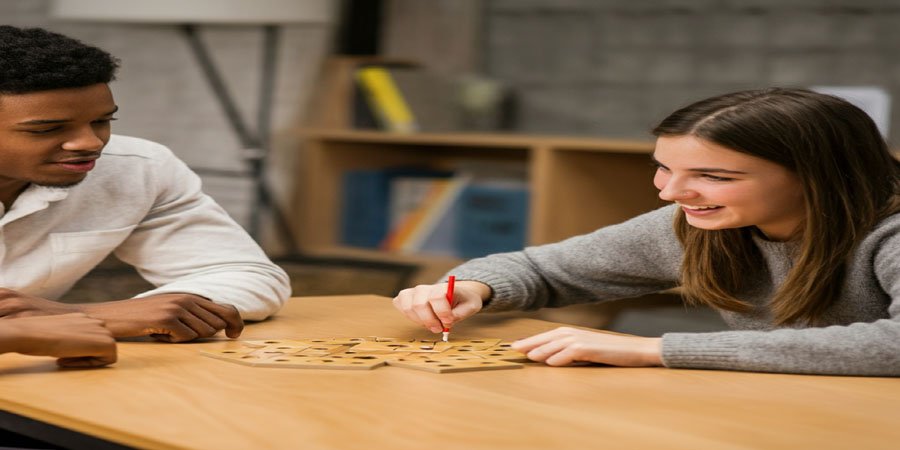
Are you in search of some team building puzzle games for adults?
Building a strong and cohesive team is essential for any organization’s success. One effective way to foster teamwork and boost morale is through experiential learning activities. Puzzle games provide a fun means to challenge your team’s problem-solving skills while promoting collaboration and communication.
In this article, let’s see 10 team building puzzle games for adults. These exercises are sure to ignite the spirit of teamwork in your workplace.
10 Team Building Puzzle Games for Adults
Here are some interactive and thought-provoking puzzle games that can be easily incorporated into your workplace.
#1. Riddle Race
In this activity, teams race against the clock to solve riddles and complete challenges. It promotes problem-solving skills, teamwork, and quick thinking.
Time: 10-20 minutes
Materials: Riddle cards with different levels of difficulty, a timer, and a prize for the winning team
Participants: Minimum of 2 teams with at least 3 members each
Instructions
- Divide the participants into groups and assign a leader for each group.
- Hand out riddle cards to each group. Example riddle: “I speak without a mouth and hear without ears. I have no body, but I come alive with wind. What am I? (Answer: Echo).”
- Set a time limit and let the groups work together to solve as many riddles as they can.
- The group with the most correct answers wins the race.
Our Observation While Running This Activity: Teams sometimes spend too long trying to solve the first difficult riddle instead of moving to another one. We found that allowing teams to switch between challenges helped them use their time more strategically.
Debrief
- What approach helped your group solve the riddles most effectively?
- Where did collaboration make the biggest difference during the race?
- How might these problem-solving habits support your team at work?
You can also read:
Top 10 Team Building Problem Solving Activities
10 Critical Thinking Team Building Activities for Work
50 Easy Team Building Activities (Workplace)
#2. Escape Room Challenge
This activity transforms your workplace or meeting area into a thrilling escape room adventure. It encourages creativity, critical thinking, and cooperation.
Time: You decide
Materials: Clues, puzzles, and a storyline
Participants: Groups of 3-8 people
Instructions
- Create a storyline and set up puzzles or challenges that must be solved to “escape” the room.
- Divide the participants into teams and explain the rules and scenario.
- Provide each team with the initial clue to get started.
- Teams must work together to solve the puzzles and overcome challenges within a designated time frame to “escape”.
Debrief
- How did your team decide which task to tackle first?
- Under time pressure, what communication choices helped most?
- In what ways did creative thinking shape your progress?
#3. Puzzle Relay
This high-energy activity combines physical movement and problem-solving. It is perfect for fostering team spirit while keeping participants active.
Time: 10-20 minutes
Materials: Jigsaw puzzles or large tangrams, tables, and a timer
Participants: 3-6 people in a group
Instructions
- Divide the participants into groups and assign each group a puzzle.
- Set up stations where each group member must take turns working on the puzzle for a set amount of time (e.g., 1 minute) before passing it off to the next member.
- The goal is to complete the puzzle as quickly as possible. Groups must strategize and communicate to work efficiently.
Debrief
- Which time-management choice helped your team most during the relay?
- When the pace picked up, how did communication affect your progress?
- What did task-sharing reveal about trust within your group?
#4. Tower of Hanoi
This classic math puzzle challenges teams to think strategically and work together to solve the problem efficiently. It emphasizes logic, critical thinking, and collaboration.
Time: 15-20 minutes
Materials: A Tower of Hanoi set (available online or homemade using discs of different sizes and three rods)
Participants: Groups of 3-8 individuals
Instructions
- Introduce the rules of the Tower of Hanoi puzzle. The objective is to move all discs from one rod to another, following the rules that only one disc can be moved at a time and a larger disc cannot be placed over a smaller one.
- Divide the participants into teams and provide each team with a Tower of Hanoi set.
- Teams must work together to complete the puzzle in the fewest number of moves possible, competing against either the clock or other teams.
Debrief
- How did your team map out moves before taking action?
- As the puzzle unfolded, what shifts in strategy helped most?
- What does this challenge show about shared decision-making under constraints?
#5. Word Search Race
This game combines a love of words with an energized team competition. It promotes a mix of analytical thinking, attention to detail, and teamwork.
Time: 10-15 minutes
Materials: Custom word search puzzles, and highlighters or markers
Participants: Teams of 3-6 members
Instructions
- Create or print large-size word search puzzles with a theme related to your organization or industry.
- Divide the participants into teams and provide each team with a word search puzzle and highlighters.
- Set a time limit, and challenge the teams to find as many words as they can.
- The team that uncovers the most words or completes the puzzle first wins.
What We Learned While Running This Activity: Simply dividing the puzzle among team members does not always make the team faster. We found that agreeing on how to divide the search area first reduced people duplicating the same work.
Debrief
- Which method helped your team cover the puzzle most efficiently?
- How did members split the work while staying aligned?
- What did this activity reveal about focus, shared effort, and team success?
#6. Puzzle Scavenger Hunt
This activity combines the excitement of a scavenger hunt with the challenge of puzzles. It encourages teamwork, communication, and problem-solving.
Time: You decide
Materials: Puzzle pieces, clues, and a list of hidden locations
Participants: Teams of 3-8 people
Instructions
- Hide puzzle pieces around the workplace or a designated area. Include clues that guide teams to each hidden location.
- Divide the participants into teams and provide them with their first clue.
- Teams must solve the clues to locate all the puzzle pieces. Once they have found all the pieces, they work together to complete the puzzle.
- The first team to finish the scavenger hunt and the puzzle wins.
Debrief
- What helped your team stay organized while chasing clues?
- How did dividing roles shape your speed or accuracy?
- Looking back, where did collaboration matter most during the hunt?
#7. Logic Grid Challenge
This mind-bending activity strengthens analytical thinking and cooperation. Here the teams tackle a logic puzzle together.
Time: 15-20 minutes
Materials: Pre-made logic grid puzzles (easily sourced online or custom-made) and pens
Participants: 3-6 individuals per group
Instructions
- Provide each group with a logic grid puzzle. The goal is to use the clues provided to fill in the grid and solve the puzzle.
- Groups must discuss and decide together how to interpret the clues and complete the grid.
- The group that solves the puzzle first or gets the furthest within the time limit wins.
Debrief
- What reasoning process helped your group make sense of the clues?
- In moments of uncertainty, how did the team use each person’s input?
- How might this experience shape the way you solve complex problems at work?
#8. Tangram Team Challenge
This classic geometry-based puzzle promotes creativity, strategic thinking, and cooperative problem-solving.
Time: 15-20 minutes
Materials: Tangram sets (seven-piece tangram puzzles) and challenge cards with shapes to recreate
Participants: 3-6 individuals per group
Instructions
- Hand each team a tangram set and a challenge card showing a shape to replicate.
- Teams must work together to recreate the shape using all seven tangram pieces.
- Set a time limit or create a series of shapes for teams to complete, with points awarded for each successful recreation.
A Small Adjustment We Made While Running This Activity: Teams can become attached to an arrangement that clearly is not working. Encouraging them to stop, reassess the shape, and try a different configuration made the problem-solving process more deliberate.
Debrief
- What helped your team interpret the shapes more clearly?
- When a design did not fit, how did the group adjust its approach?
- Which creative choice improved teamwork the most during the challenge?
#9. Code Breaker
This activity challenges teams to work together to decode messages. It encourages problem-solving, collaboration, and out-of-the-box thinking.
Time: 10-20 minutes
Materials: Pre-made coded messages, pens, and a cipher or key for decoding
Participants: Teams of 3-6 members
Instructions
- Provide each team with a coded message and a cipher or decoding key.
- Teams must work together to decode the message within the given time limit.
- The team that successfully decodes the message the fastest wins.
Debrief
- How did your team decide which decoding ideas to test first?
- What role did creative thinking play when the message seemed hard to crack?
- In what ways did collaboration help your group solve the code more efficiently?
#10. Build the Bridge
This hands-on activity involves engineering and teamwork. Here the participants work together to build a sturdy bridge using provided materials.
Time: You decide
Materials: Materials such as straws, tape, paper clips, string, and other crafting supplies
Participants: 3-8 people per group
Instructions
- Assign the groups the task of building a functional bridge that can support a small object (e.g., a toy car or a book).
- Provide the materials and set a time limit for construction.
- Once time is up, test each group’s bridge for strength and stability.
- The group with the most creative or functional design wins.
Debrief
- How did your group plan the bridge before building it?
- What task split helped the team work most smoothly?
- In this challenge, how did creativity plus problem-solving shape the final result?
Want to Develop Leaders at Every Level of Your Organization?
If you want a practical system to develop leaders at all levels, get this master guide and apply our proprietary ZIGN Framework™ of Leadership:
Looking for Unique Team Building Activities?
If you want unique activities that help your workforce grow through every stage of team development, get this guide:
Need Fresh Team Building Activities Every Month?
If you are a busy leader, get 5 unique, fully customizable activities every month—no preparation or trainer required.
Final Words
By incorporating these puzzle games into your next staff meeting or training session, you can strengthen your team’s communication, problem-solving, and collaboration skills. At the same time, you can have fun. These activities promote a positive and supportive team dynamic that will translate into the workplace, leading to increased productivity. Remember, the key to a successful team building exercise is to provide a supportive environment where everyone can actively participate and contribute to the shared goals.
FAQ: Team Building Puzzle Games
You might have these questions in mind.
How do I choose the right game for my group?
Consider your team’s specific needs, size, and dynamics. Think about the goals you want to achieve, such as improving communication, fostering creativity, or enhancing problem-solving skills. Additionally, consider the time frame, available resources, and whether the activity will be conducted in-person or virtually.
Are these activities suitable for remote teams?
Yes! Many of these activities can be adapted for virtual settings. For example, logic puzzles, code breakers, and tangram challenges can be shared digitally, allowing teams to collaborate through video conferencing platforms. Ensure that you provide clear instructions and facilitate engagement to make virtual activities fun as well as effective.
How often should these activities be done?
The frequency of these activities depends on your organization’s culture and team needs. Some teams may benefit from monthly activities, while others might find them more effective quarterly or during key project milestones. Regularly incorporating experiential learning activities helps maintain strong morale and collaboration over time.
Can these exercises be effective for new teams?
Absolutely! These exercises are an excellent way for new teams to break the ice and begin developing trust and communication early in their collaboration. These activities can lay a strong foundation for lasting teamwork and shared goals.
Like this article on “10 Team Building Puzzle Games for Adults”? Feel free to share your thoughts.
