
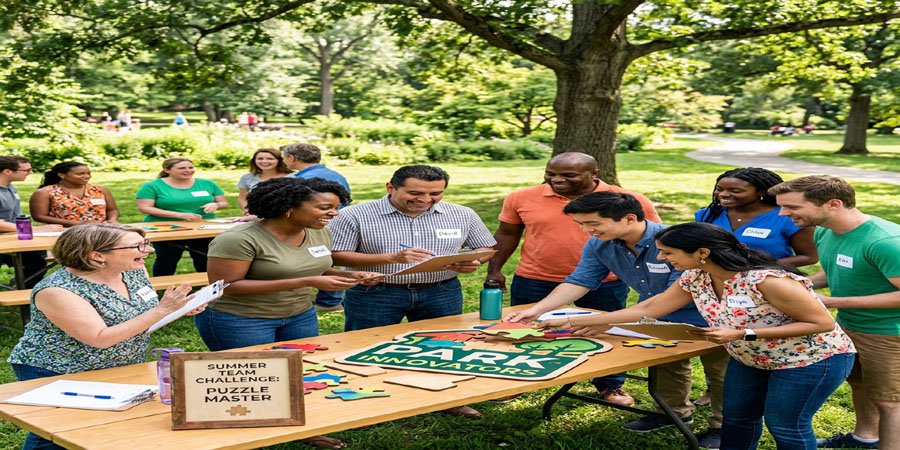
Are you in search of Summer Team Building Activities?
Warm weather gives people a natural reason to step away from routine work patterns and connect in fresh ways. Short outdoor or seasonal exercises can improve communication, boost energy, and help coworkers learn how others think under light pressure. The best options are easy to run, simple to explain, and focused on participation instead of competition alone. When chosen well, they create shared moments that carry back into daily collaboration.
In this article, let’s see 10 Team Building Exercises that you can try during summer.
Here is an overview of the sections in this article:
- Key factors to review before planning these sessions.
- Ten Summer Team Building Activities with instructions, and debrief questions.
- Frequently Asked Questions.
So, let’s get started!
What Should You Consider Before Conducting These Activities?
Before you begin, review these practical tips to make each session smooth, useful, and enjoyable.
Match the Activity to the Goal
Start by deciding what success looks like before picking an exercise. Some options build trust, while others improve focus, listening, or quick problem-solving. When your goal is clear, you can choose a format that fits the mood, time, and people involved.
Keep Weather and Comfort in Mind
Outdoor plans should account for heat, shade, hydration, and movement level. A simple activity can fail when people feel tired or uncomfortable. Check the forecast, provide water, and choose spaces that support safe participation without making anyone feel physically stretched.
Set Clear Instructions Before Starting
People engage faster when the rules are simple and direct. Explain the aim, time limit, and expected outcome in plain language. Clear guidance reduces confusion, avoids wasted minutes, and helps everyone focus on the experience instead of trying to decode the activity.
Make Participation Feel Safe and Inclusive
Not everyone enjoys loud competition or quick public speaking. Offer roles that suit different comfort levels so more people can contribute. Inclusive design helps quieter participants join in, supports varied strengths, and creates a better shared experience for the whole room.
Leave Time for Reflection Afterward
The discussion after an exercise often matters more than the task itself. Reflection helps people connect actions with workplace habits, communication styles, and decision patterns. A short debrief turns a fun moment into a practical learning experience people remember later.
10 Summer Team Building Activities
Here are some Summer Team Building Activities you can try.
#1. Ice Melt Challenge
This quick exercise asks people to free a small object from ice using limited tools and creative thinking. It works well for building fast cooperation while keeping the mood playful and light.
Time: 10-20 minutes
Materials: Ice Cubes, Small Plastic Tokens, Towels, Cups, and Warm Water
Participants: 3-8 people per group
Instructions
- Give each group one frozen item (ice cube) and explain that the goal is to release it before time runs out.
- Ask participants to plan their approach for one minute before touching the materials.
- Allow them to use only the provided items to solve the challenge. For example, they may pour warm water slowly or wrap the ice in a towel.
- End the round when the object is released or when the timer reaches 10-15 minutes.
Debrief
- What approach helped your group make progress fastest?
- How did you decide who would do each task?
- What did this activity show about solving small problems together?
You can also read:
50 Awesome Team Building Activities (Workplace)
#2. Backyard Scavenger Sprint
This fast-paced search game gets people moving while encouraging observation, quick planning, and shared decision-making. It is especially useful when you want a simple activity that brings energy into a short gathering.
Time: 10-20 minutes
Materials: Item Lists, Pens, Clipboards, and Small Prizes
Participants: 3-8 people per group
Instructions
- Hand each team a list of seasonal objects or clues to find within the set area.
- Explain the boundaries clearly so teams know where they can search safely.
- Ask them to collect items or record answers before time ends. For instance, the list might include a yellow flower, a smooth stone, or something that smells fresh.
- Review findings together and confirm which entries meet the challenge requirements.
Debrief
- How did your team divide the search work?
- Which choices helped you move faster without getting confused?
- What did you learn about balancing speed with accuracy?
#3. Water Relay Strategy
This activity combines movement with planning as participants try to transfer water from one container to another with minimal loss. It encourages discussion, role assignment, and quick adjustment after mistakes.
Time: 10-20 minutes
Materials: Buckets, Cups, Spoons, Sponges, and Water
Participants: 3-8 people per group
Instructions
- Place a full bucket at the start line and an empty bucket several steps away.
- Tell the group that they must move as much water as possible before the timer ends.
- Limit the tools they can use during each round so they need a plan. For example, one round may allow only spoons, while another allows only sponges.
- Measure the final amount moved and invite everyone to compare methods.
Debrief
- What strategy changed your results the most?
- How did your group react when the first idea was not efficient?
- Where do you see a similar need for adjustment at work?
#4. Picnic Blanket Puzzle Race
This challenge asks participants to solve a puzzle while staying within a small shared space, which promotes coordination and patience. It is a calm option for mixed energy levels and works well in parks or open offices.
Time: 10-20 minutes
Materials: Picnic Blankets, Simple Puzzles, and Timers
Participants: 3-8 people per group
Instructions
- Give each group a blanket and a puzzle. Then, ask everyone to stay on the blanket and solve the puzzle.
- Explain that no puzzle piece can be thrown, hidden, or placed outside the blanket.
- Encourage participants to assign roles before they begin. For example, one person can sort edges while another matches colors.
- Stop the activity at the time limit and review how close each group came to completion.
Debrief
- How did the small shared space affect communication?
- What role choices made the process smoother?
- What did this reveal about working closely under minor constraints?
#5. Lemonade Pitch Challenge
In this creative exercise, participants design a quick sales pitch for a pretend summer lemonade stand. It helps strengthen idea generation, audience awareness, and concise speaking under a short deadline.
Time: 10-20 minutes
Materials: Paper, Markers, Pitch Prompts, and Timer
Participants: 3-8 people per group
Instructions
- Ask each team to imagine they are launching a lemonade stand with a unique selling angle.
- Give them a prompt card that defines the audience, budget, or style of pitch.
- Tell teams to prepare a one-minute presentation before time ends. For example, they might pitch to busy parents, fitness fans, or festival visitors.
- Invite each team to present, then note what made each message clear and memorable.
Debrief
- How did your team decide which ideas were worth keeping?
- What made certain pitches more persuasive than others?
- How can this kind of quick alignment help with real work presentations?
#6. Shade Spot Story Chain
This low-pressure game invites participants to build a shared story one sentence at a time using a summer theme. It supports listening, adaptability, and attention to the ideas that come before your own.
Time: 10-20 minutes
Materials: Story Prompts and Timer
Participants: 3-8 people per group
Instructions
- Seat each group in a circle and give them a simple starting line for the story.
- Explain that each person adds one sentence that must connect clearly to the previous one.
- Introduce a light rule to keep it engaging. For instance, every third sentence must include a summer object like sunglasses or a picnic basket.
- End after a set number of rounds and ask one person to retell the full story.
Debrief
- What helped your group keep the story coherent?
- How did you respond when the direction changed unexpectedly?
- What does this activity suggest about listening before acting?
#7. Sidewalk Chalk Map Mission
Participants create a visual map that guides others through a made-up summer adventure route. This activity supports planning, visual communication, and the ability to explain ideas in a way others can follow.
Time: 10-20 minutes
Materials: Sidewalk Chalk, Cones, and Prompt Cards
Participants: 3-8 people per group
Instructions
- Assign each team a mission, such as drawing a map to a picnic site, beach stand, or hidden garden.
- Mark a pavement area where each team can design its route and symbols.
- Ask them to make the map clear enough for another team to interpret. For example, they can use arrows, landmarks, or color codes.
- Let teams swap maps and test whether they can follow the intended path correctly.
Debrief
- What made your team’s map easy or hard to understand?
- How did you decide which details mattered most?
- Where does clear visual communication matter in your daily work?
#8. Quick Build Beach Tower
This hands-on challenge asks people to build the tallest stable tower from simple materials inspired by beach gear. It promotes experimentation, short planning cycles, and practical collaboration under a clear limit.
Time: 10-20 minutes
Materials: Paper Cups, Straws, Tape, String, and Sand Buckets
Participants: 3-8 people per group
Instructions
- Give each group the same set of materials and explain that height matters only if the tower stands alone.
- Allow two minutes for planning before anyone begins building.
- Remind participants that they can revise their design during the challenge. For example, they may widen the base after noticing the top becomes unstable.
- Measure each final structure and discuss which design choices improved stability.
Debrief
- What did your group learn from early design mistakes?
- How did planning compare with hands-on testing?
- What workplace tasks also improve through quick iteration?
#9. Summer Sound Guess-Off
This listening game uses familiar seasonal sounds to encourage focus, interpretation, and discussion. It is easy to run indoors or outdoors, making it useful when space or energy levels are limited.
Time: 10-20 minutes
Materials: Audio Clips, Speaker, Answer Sheets, and Pens
Participants: 3-8 people per group
Instructions
- Play short clips of summer-related sounds, one at a time, for all teams.
- Tell teams to discuss each sound briefly before writing a shared answer.
- Mix easy and difficult clips to keep the round balanced. For instance, include waves, an ice cream truck bell, sandals on gravel, or a sprinkler.
- Review answers together and ask teams to explain how they reached close guesses.
Debrief
- How did your team handle uncertain answers?
- What listening habits helped you interpret the sounds better?
- How can stronger listening improve collaboration during busy workdays?
#10. Sunset Values Line-Up
This reflective activity asks participants to rank shared workplace values through movement and discussion. It creates thoughtful conversation while staying simple, quick, and appropriate for the close of an event.
Time: 10-20 minutes
Materials: Value Cards, Tape, and Open Space
Participants: 3-8 people per group
Instructions
- Place value cards on the ground and mark a line that represents priority from low to high.
- Ask the group to position each value along the line based on shared discussion.
- Encourage everyone to explain placements with short reasoning. For example, trust might rank above speed if the group believes accuracy depends on openness.
- Review the final order and invite the group to adjust one choice if they reach a new insight.
Debrief
- Which value sparked the most discussion, and why?
- How did your group work through different opinions?
- What does your final ranking say about how you want to work together?
Want to Develop Leaders at Every Level of Your Organization?
If you want a practical system to develop leaders at all levels, get this master guide and apply our proprietary ZIGN Framework™ of Leadership:
Looking for Unique Team Building Activities?
If you want unique activities that help your workforce grow through every stage of team development, get this guide:
Need Fresh Team Building Activities Every Month?
If you are a busy leader, get 5 unique, fully customizable activities every month—no preparation or trainer required.
Final Words
Short seasonal exercises can create meaningful connection when they are planned with a clear purpose. The strongest options are simple to run, easy to join, and followed by honest reflection. A good debrief helps people turn a fun moment into a useful lesson about communication, trust, or problem-solving. You do not need a large budget to make these sessions effective. Pick one activity, run it well, and use the discussion to carry the value back into everyday work.
FAQ: Summer Team Building Activities
You might have these questions in mind.
Are these activities suitable for small workplaces?
Yes, these ideas work very well for small workplaces. Most require only a few materials, simple setup, and limited space. They also fit short schedules, which helps busy staff join without stress. Smaller workplaces often benefit more because participation feels personal, direct, and highly interactive.
How do I choose the right activity?
Start by identifying your main goal for the session. Some ideas focus on communication, while others support creativity or trust. Next, review time, space, and comfort levels before choosing. The best option is one that matches your people, setting, and expected energy.
Can these activities work indoors too?
Yes, many of these ideas can be adapted indoors. Sound games, story exercises, pitch tasks, and puzzle challenges work especially well inside. You may need to adjust materials, movement, or layout slightly. The core value stays the same when the instructions remain clear and focused.
Why is the debrief so important?
The debrief helps people make sense of what happened. Without reflection, an exercise may feel fun but leave little lasting value. Good questions connect the experience to habits, choices, and communication patterns. That step turns a short activity into a stronger learning opportunity.
How often should we run these sessions?
That depends on your schedule, goals, and workplace rhythm. Many organizations benefit from running one short activity each month during warmer seasons. Others use them during off-sites, staff meetings, or social gatherings. Consistency matters more than frequency because regular practice builds stronger shared habits.
Like this article on “10 Summer Team Building Activities”? Feel free to share your thoughts.
