

Are you in search of some performance management activities?
As a leader, it’s important to ensure that your employees perform at their best potential. Nowadays, companies spend a lot of resources on training their employees. However, engaging them in activities that help hone their skills and improve their performance is equally important.
In this article, let’s see 10 team building activities you can try in your workplace for performance management. Incorporating these exercises into your routine can help keep your team motivated, engaged, and focused.
Here is an overview of the sections in this article:
- 10 Performance Management Activities for the Workplace
- Tips for Successful Facilitation
- Frequently Asked Questions
So, let’s get started!
10 Performance Management Activities for the Workplace
Here are some helpful team building exercises for performance management training.
#1. Goal Setting Game
In this game, employees set goals and present them to the group. It promotes collaboration and accountability.
Time: 10-20 minutes
Materials: Paper and Pen
Participants: 3-6 people per group
Instructions
- Divide the employees into groups and give the materials to each person.
- Ask each person to write 2 meaningful goals in 3 minutes—one personal goal and one team goal.
- Have each person briefly present their goals and explain how they plan to achieve them. Allow 1 minute per person.
- Ask the group to choose one of the team goals and decide on one action they will take toward achieving it. Allow 3 minutes.
Debrief
- Which goals seemed to matter most across the group, and why?
- Where might people face roadblocks as they work toward these goals?
- In what ways can team members support each other through those challenges?
You can also read:
10 Strategies to Reduce Employee Turnover
The 10 Best Performance Appraisal Books
10 People Management Games for Leaders
#2. Reflect and Connect Session
This activity encourages reflective thinking and team connection. It focuses on understanding individual as well as group experiences.
Time: 10-15 minutes
Materials: Pen and paper
Participants: 2-10 people per group
Instructions
- Participants write down a recent challenge they faced at work and the steps they took to overcome it.
- Each member shares their story with the group, highlighting the lessons learned.
- Peers provide feedback and discuss similar experiences, thereby building empathy and connection.
Debrief
- What patterns stood out in how people handled their challenges?
- Which shared struggles revealed the strongest opportunities for team support?
- How could these insights shape stronger collaboration in everyday work?
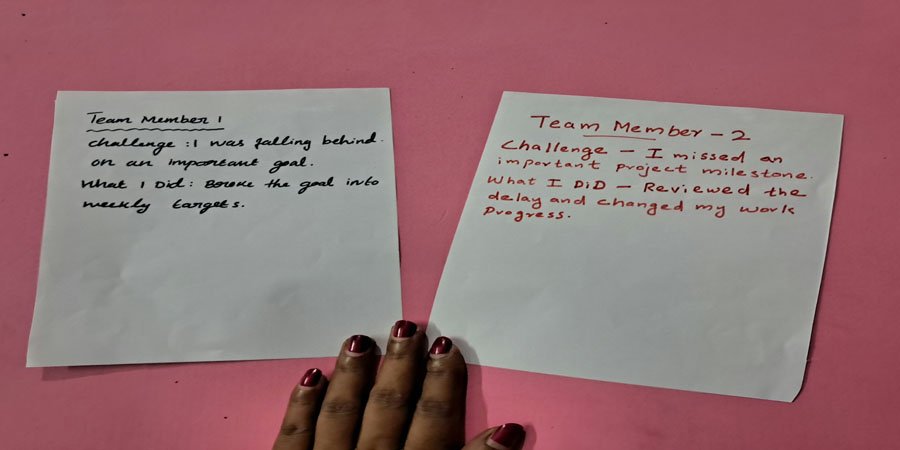
Our Experience While Running This Activity: We noticed that sharing a real workplace challenge led to much more useful discussion than asking team members to talk about performance in general terms. Keeping the stories specific helped our team connect individual experiences to practical ways of supporting one another.
#3. Feedback Relay Race
This is a dynamic exercise designed to sharpen communication. It also improves the feedback exchange process among employees.
Time: 10-20 minutes
Materials: Feedback forms, pens, and a timer
Participants: 4-8 people per group
Instructions
- Arrange the group in two lines of chairs facing each other. Next, give each person a feedback form and pen.
- Ask each person to write one piece of constructive feedback for the person sitting opposite them in 2 minutes.
- Have everyone move one seat to the right and repeat the process until everyone has given and received feedback, allowing 2 minutes for each round.
- After the final round, let everyone review the feedback they received.
Debrief
- When did the feedback feel most clear and useful during the activity?
- Which communication habits helped people share input in a constructive way?
- How might your team use this feedback approach in daily work to improve performance?
#4. Mindful Communication Challenge
This activity can promote active listening and thoughtful expression, key components of effective workplace communication.
Time: 10-15 minutes
Materials: Nothing required
Participants: Pairs
Instructions
- Pair up participants and assign them roles: one as the speaker and one as the listener.
- The speaker discusses a recent work challenge while the listener practices active listening – no interruptions or responses.
- After some time, the listener summarizes what was heard to confirm understanding. Then, they switch roles and repeat the process.
Debrief
- When did you feel most understood during this exercise, and what made that moment effective?
- Which listening habits helped build clearer understanding between partners?
- How could stronger communication like this improve performance in your daily work?
#5. Objective Mapping
This is one of the best performance management activities that helps employees align their individual goals with the wider team objectives. It’s a great way to instill a sense of collective responsibility and focus within the team.
Time: 10-20 minutes
Materials: Nothing required
Participants: 3-6 individuals in a group
Instructions
- Assign each team member a role and explain how their individual goals fit within the team’s broader objectives.
- Instruct each member to explain their role’s impact on team success. For example, “As the marketing lead, I am responsible for increasing brand awareness which ultimately contributes to the team’s goal of increasing sales.”
- Encourage open discussion and collaboration to identify ways in which individual goals can support each other.
Debrief
- How did this activity clarify the connection between individual roles and team goals?
- Where did you notice the strongest sense of alignment during the discussion?
- What could help your team stay focused on a shared objective after this exercise?
#6. Scenario Sprint
This is an invigorating exercise where teams swiftly tackle fictional business scenarios. It can sharpen their collaborative problem-solving skills.
Time: 10-15 minutes
Materials: Whiteboard (or digital equivalent), markers, and timer
Participants: 3-6 people per group
Instructions
- Present some realistic business scenarios to the team one by one.
For example,
“Your company’s biggest client has just announced that they are ending their contract with you. How do you handle this situation?”
“Your team’s project deadline has been moved up by two weeks. How will you adjust your plans and communicate with stakeholders?”
- Set a strict timer for each scenario, challenging the teams to come up with a solution in a short amount of time.
Debrief
- Where did your team combine different strengths most effectively during the scenario?
- Under pressure, what helped the group stay focused and make progress?
- Which lesson from this exercise could improve how your team uses shared expertise at work?
#7. Strategy Circle
This is one of the amazing performance management exercises that helps employees to feel heard and valued. It also promotes a culture of continuous improvement and growth.
Time: 10-20 minutes
Materials: Whiteboard and markers
Participants: 3-6 members per group
Instructions
- Start by having each member recall a specific aspect of a past project that was notably effective or in need of improvement.
- Facilitate open discussion, allowing each participant to provide feedback on others’ observations and to offer their own insights.
- Use the whiteboard to categorize feedback into ‘Keep’ (successful strategies) and ‘Improve’ (areas for growth) to visually summarize the session.
- Conclude by setting actionable goals for future projects based on the collective insights gained from the discussion.
A Small Adjustment We Made While Running This Activity: We found that putting every comment on the board at once made it harder to see which ideas actually mattered. We started grouping similar points together during the discussion, which made the final “Keep” and “Improve” lists much clearer.
Debrief
- Looking at the “Keep” ideas, which ones feel most valuable to carry into future projects?
- Where does your team see the biggest need for improvement after this discussion?
- What specific steps could help turn today’s insights into better teamwork going forward?
#8. Skill Share
This activity leverages the diverse expertise within a team to foster mutual growth and learning.
Time: 10-20 minutes
Materials: Nothing required
Participants: 3-8 people per group
Instructions
- Select one member from each group to act as the featured skill sharer for the session.
- Allow the chosen presenter a strict 5-minute window to teach a unique skill or share a specific area of knowledge with the group.
- Spend 5 minutes after the presentation allowing the group to ask questions and discuss how they can apply the skill to their daily work.
Debrief
- Which shared skills or insights felt most useful to the group during this activity?
- In what ways could learning from one another strengthen teamwork in daily tasks?
- What would help your team apply these new skills more often at work?
#9. Lost at Sea
This is a survival game designed to sharpen decision-making and problem-solving skills under pressure.
Time: 10-15 minutes
Materials: A list of items for survival
Participants: Groups of 3-6 people
Instructions
- Provide each group with a survival scenario where they are stranded at sea following a shipwreck.
- They have a list of 10-15 items available, but can only choose a few to survive. For example, some of the items available are food, water, a compass, a life raft, a flare gun, etc.
- The group must discuss and decide together which five items they will choose to take with them on the life raft.
- After some time, have each group present their chosen items and explain their reasoning.
What We Learned While Running This Activity: Our teams sometimes spent too much time defending individual item choices instead of evaluating the options together. We learned that asking people to explain the reasoning behind their choices shifted the discussion from personal preferences toward collective decision-making.
Debrief
- During the discussion, how did your group decide which ideas mattered most?
- What did you notice about the role of different perspectives in shaping the final choices?
- Looking back, where did collective reasoning help the team reach a better outcome?
#10. The Great Debate
This exercise encourages critical thinking and the art of persuasion within a cooperative framework.
Time: 10-20 minutes
Materials: Timer
Participants: 2-6 individuals in a group
Instructions
- Start by dividing participants into small teams and assign each a stand on various debate topics. Topics should be non-controversial and related to work or daily life, such as “Remote work vs. Office work” or “Is the customer always right?”
- Set a timer for each debate round, allowing teams to present their arguments and rebuttals.
- Encourage teams to use facts, stories, and rhetorical questions to strengthen their arguments.
Debrief
- Which persuasive techniques made arguments more convincing during the debate?
- How did open dialogue affect the way differences were explored or resolved?
- In your daily work, where could these discussion skills lead to stronger communication or better performance?
Want to Develop Leaders at Every Level of Your Organization?
If you want a practical system to develop leaders at all levels, get this master guide and apply our proprietary ZIGN Framework™ of Leadership:
Looking for Unique Team Building Activities?
If you want unique activities that help your workforce grow through every stage of team development, get this guide:
Need Fresh Team Building Activities Every Month?
If you are a busy leader, get 5 unique, fully customizable activities every month—no preparation or trainer required.
Tips for Successful Facilitation
Effective facilitation is the backbone of successful performance management activities. It is about creating an environment where teams feel comfortable sharing, learning, and growing together.
Here are some tips to help you successfully facilitate these exercises.
Set the Tone for Openness
Establish a safe and respectful atmosphere where team members feel encouraged to share their thoughts and feelings. Clearly communicate the ground rules and expectations. This sets the stage for honest and productive conversations.
Be a Neutral Guide
Facilitate the conversation without imposing your own views or biases. Focus on guiding the process and keeping the discussion on track. This helps build trust and ensures everyone has a chance to contribute.
Get Everyone Involved
Use strategies to draw out quieter team members and manage dominant voices. Techniques like think-pair-share or small group discussions can help. The goal is to create a space where everyone’s input is valued.
Make it Relevant
Help team members see the connection between the activity and their everyday work challenges. Encourage them to reflect on how they can apply insights to their roles. This increases engagement and makes the activity more impactful.
Wrap Up with Impact
Lead a focused debrief that highlights key takeaways and insights. Emphasize actionable steps and next steps. This helps teams translate learning into tangible results.
Final Words
In conclusion, performance management is a dynamic process that optimizes efficiency and drives organizational success. It hinges on clear objectives, regular feedback, and a culture of continuous improvement. Hopefully, the above exercises can help you motivate your team for better performance management outcomes.
FAQ: Performance Management Activities
You might have these questions in mind.
What is the purpose of performance management activities?
Performance management activities help teams work together effectively to achieve shared goals. They promote communication, collaboration, and continuous improvement. These activities also help identify areas for development and build a supportive team culture. By properly managing performance, organizations can drive growth and success.
How do I choose the right performance management activity?
Choose an activity that aligns with your team’s needs and goals. Consider the size of your team, the time available, and the specific challenges you’re facing. Look for activities that promote engagement, interaction, and learning. This will help ensure maximum participation and impact.
Can these activities be done remotely?
Yes, many of these activities can be adapted for remote teams. Use virtual tools or platforms to facilitate communication and collaboration. Activities such as the Mindful Communication Challenge, Objective Mapping, and Skill Share can be effective. With a little creativity, remote teams can benefit from these exercises too.
How often should we do these exercises?
The frequency depends on your team’s needs and goals. Some teams benefit from regular weekly or monthly sessions, while others prefer quarterly or bi-annual activities. Start with a schedule that works for your team and adjust as needed. Consistency is key to seeing results.
How do I measure the effectiveness of these activities?
Measure effectiveness through feedback, surveys, and tracking key performance indicators (KPIs). Look for improvements in team communication, collaboration, and goal achievement. Use this data to refine and adjust your approach. This will help you maximize the impact of your activities.
Like this article on “10 Performance Management Activities for the Workplace”? Feel free to share your thoughts.
