
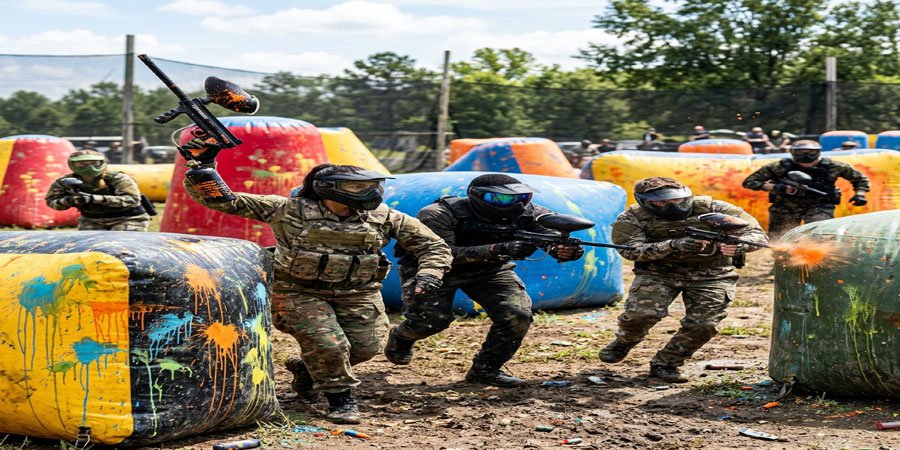
Do you want to conduct the Paintball Game with your teams?
This activity is built on experiential learning, where people learn by acting, reflecting, then adjusting their approach. It also draws from group dynamics because players must read cues, share roles, manage pressure, and respond to changing conditions. The exercise supports trust-building by placing participants in a shared challenge with clear limits. It also strengthens decision-making because every move has visible results.
In this article, let’s see how you can conduct this activity with your teams.
Here is an overview of the sections in this article:
- Objective of the Activity
- 5 Variations of the Paintball Game
- Tips for Successful Facilitation
- Frequently Asked Questions about the Exercise
So, let’s get started!
Objective of the Activity
The Paintball Game helps people practice communication, strategy, trust, and quick decision-making in a lively setting. It turns abstract workplace skills into visible actions that participants can discuss after the round.
Here are the key objectives you can focus on during facilitation.
Building Clear Communication
This exercise helps participants see how clear messages affect action under pressure. Short calls, agreed signals, quick updates, and direct feedback reduce confusion during play. When people notice how missed information changes outcomes, they become more mindful communicators. The lesson transfers well to workplace tasks where timing, clarity, focus, and shared awareness matter during fast-moving situations.
Strengthening Strategic Thinking
The activity encourages participants to plan before acting, then adapt when the situation changes. They must consider positioning, timing, available cover, role balance, and likely responses from others. This helps people compare careful planning with reactive behavior. By reviewing what worked, they learn how strategy improves results when goals are clear but conditions keep shifting.
Developing Trust Under Pressure
Trust grows when participants rely on one another during a shared challenge. Players must believe that others will cover space, follow plans, communicate risks, and support agreed roles. The exercise makes trust practical rather than abstract. During debriefing, people can discuss how confidence, dependability, courage, and steady communication helped them move through uncertainty together.
Revealing Leadership and Team Roles
The session shows how leadership can shift based on need, not only title. Some participants may guide strategy, while others observe patterns, protect space, coordinate movement, or keep morale steady. These natural roles often appear quickly during play. Reviewing them helps people understand contribution styles, hidden strengths, decision habits, and leadership behaviors in a practical way.
Improving Conflict Management
Fast-paced play can create disagreement about plans, mistakes, priorities, or risk. This gives facilitators a safe way to discuss how people handle tension. Participants learn to pause, clarify intent, reset expectations, and choose useful responses. When managed well, the activity shows that conflict can produce better decisions when respect, timing, and accountability stay present.
5 Variations of the Paintball Game
Here are 5 variations of the Paintball Game for your teams.
#1. Classic Paintball Game
This classic version focuses on tagging opponents while protecting your own side within a small field. The short format keeps energy high, while still allowing planning, movement, communication, and review.
Time: 10-20 minutes
Materials: Paintball Markers, Protective Masks, Paintballs, Boundary Cones, and Colored Armbands
Participants: 3-8 people per group
Instructions
- Set up the playing field with clear boundaries, place safe cover points, and mark a visible start line for both teams.
- Split participants into two balanced teams and explain the rules: the goal is to tag players on the other team while avoiding being tagged yourself.
- Begin a 10-minute round. Instruct players to raise a hand immediately if they notice a safety concern so play can pause right away.
- Award one point for every clear tag, such as a visible paint mark on a vest or arm.
Debrief
- What communication helped you make better choices?
- Where did your plan work well under pressure?
- What would you change if you played another round?
You can also read:
50 Awesome Team Building Activities (Workplace)
#2. Capture the Flag Sprint
This version adds a simple flag objective that encourages movement, planning, and role clarity. Participants must balance offense with defense while deciding when to advance, hold position, or reset.
Time: 10-20 minutes
Materials: Paintball Markers, Protective Masks, Paintballs, Two Flags, Boundary Cones, and Colored Armbands
Participants: 3-8 people per group
Instructions
- Place one flag at each team’s base and clearly mark a center line to separate the two areas.
- Go over the rules: each team tries to take the other team’s flag and bring it safely to their own base without getting tagged.
- Ask participants to assign themselves roles before play starts, such as runner, defender, scout, or blocker, so everyone knows their job.
- End the round if a flag is captured, if time runs out, or if the facilitator needs to pause the game for safety.
Debrief
- How did role clarity affect your choices?
- What made a flag attempt successful or difficult?
- How did you balance caution with action?
#3. Protect the Leader Challenge
This variation gives one participant a protected leader role, which makes support behavior easy to observe. The goal is to escort that person across the field while maintaining awareness, spacing, and steady communication.
Time: 10-20 minutes
Materials: Paintball Markers, Protective Masks, Paintballs, Leader Vest, Boundary Cones, and Stopwatches
Participants: 3-8 people per group
Instructions
- Choose one participant to be the leader for each side and clearly identify them with a leader vest before starting the game.
- Explain to everyone that the team’s job is to guide and protect their leader all the way from the start zone to the finish zone while avoiding paintball tags.
- Give teams a moment to plan how they will escort their leader; for example, two people lead in front while one watches the back.
- Start the timer for 10 minutes. The round ends when the leader reaches the finish zone or is tagged by an opponent.
Debrief
- How did the protected role change your behavior?
- What support actions made the biggest difference?
- When did communication feel most important?
#4. Silent Strategy Round
This version removes verbal communication during play, which highlights planning, signals, and observation. It works well when you want participants to notice body language, assumptions, and the value of preparation.
Time: 10-20 minutes
Materials: Paintball Markers, Protective Masks, Paintballs, Signal Cards, Boundary Cones, and Colored Armbands
Participants: 3-8 people per group
Instructions
- Give everyone three minutes before play starts to work with their team and agree on hand signals or gestures for silent communication.
- Make it clear that no speaking is allowed during play. Only nonverbal signals, gestures, and movement cues can be used once the round begins.
- Begin the round and have teams use their planned silent signals to share information and coordinate movement without words.
- Stop the round after 10 minutes, or earlier if both sides become stuck, and take a moment for quick group reflection before resetting if needed.
Debrief
- Which nonverbal signals were most useful?
- What assumptions caused confusion during play?
- How can silent planning lessons apply at work?
#5. Mission Card Scenario
This variation uses a hidden mission card to create a focused workplace-style challenge. It encourages participants to interpret goals, assign responsibilities, and adjust quickly when the plan meets resistance.
Time: 10-20 minutes
Materials: Paintball Markers, Protective Masks, Paintballs, Mission Cards, Boundary Cones, and Colored Armbands
Participants: 3-8 people per group
Instructions
- Hand out one hidden mission card to each team—for example, defend a zone, escort a player, or retrieve an object—and ask teams to read their mission quietly.
- Allow two minutes for each team to discuss and plan their strategy together, reminding everyone to keep their mission secret from the other side.
- Announce the start and let participants begin play, reminding all players that safety and controlled movement are more important than speed.
- Stop play after 10 minutes, then have each team reveal their mission so you can discuss the choices and results.
Debrief
- How did the hidden mission shape your priorities?
- What helped you adapt when the plan changed?
- Which workplace situations feel similar to this challenge?
Want to Develop Leaders at Every Level of Your Organization?
If you want a practical system to develop leaders at all levels, get this master guide and apply our proprietary ZIGN Framework™ of Leadership:
Looking for Unique Team Building Activities?
If you want unique activities that help your workforce grow through every stage of team development, get this guide:
Need Fresh Team Building Activities Every Month?
If you are a busy leader, get 5 unique, fully customizable activities every month—no preparation or trainer required.
Tips for Successful Facilitation
Strong facilitation turns a fun outdoor challenge into a meaningful workplace learning experience. Your role is to protect safety, guide reflection, and connect actions on the field with everyday collaboration.
Use these tips to make the session smooth, inclusive, and useful.
Create a Safe and Inclusive Environment
Safety must come before competition because trust depends on clear boundaries. Explain protective gear, field limits, stop signals, and expected conduct before anyone starts. Invite participants to share comfort levels, physical limits, or concerns in private if needed. Keep the pace manageable so newer players can participate with confidence. When people feel respected, they take better risks, communicate honestly, and engage more fully during reflection.
Set Clear Rules Before Play
Clear rules reduce confusion, prevent arguments, and help people focus on learning goals. Explain scoring, hit zones, respawn options, time limits, and safety stops in simple language. Demonstrate anything that might be misunderstood before the round begins. If a rule changes between variations, state it clearly before play restarts. Good structure supports fair participation, which makes the debrief more useful because outcomes feel easier to interpret.
Link Actions to Workplace Behaviors
The value of the exercise comes from connecting field behavior to workplace habits. During debriefing, ask participants to name moments that showed planning, trust, listening, pressure, or conflict. Then help them translate those moments into meeting behavior, project work, customer response, or leadership practice. Keep the link practical rather than forced. People learn more when they can see how one small action reflects a real work pattern.
Balance Competition With Reflection
Competition can increase energy, yet reflection creates the lasting lesson. Keep rounds short so participants have enough time to discuss what happened. Avoid letting scores dominate the experience because winning may hide useful learning. Ask questions about decisions, signals, assumptions, and support behavior. When the tone stays curious, people become more willing to discuss mistakes. That honesty makes the session more valuable for future workplace collaboration.
Adapt the Activity to the Group
Every workplace has different comfort levels, energy, and physical ability. Adjust the field size, pace, gear requirements, and mission difficulty so the challenge feels fair. Offer observer roles for anyone who should not play, then include them in feedback. You can also use foam markers if needed. Adaptation does not weaken the activity; it makes participation broader, safer, and more relevant for the people in front of you.
Final Words
The Paintball Game can be a strong way to build communication, trust, planning, and leadership in a hands-on format. When you keep the rounds short, the learning stays focused and easy to discuss. The best results come from clear rules, safe facilitation, and thoughtful debriefing. Each variation gives participants a different lens for understanding how they work together. Use the exercise with care, then connect every insight back to real workplace behavior.
FAQ: Paintball Game
You might have these questions in mind.
Is the Paintball Game suitable for all workplaces?
It can work well for many workplaces, but facilitators should consider safety, comfort, mobility, and company culture first. Some people may prefer observer, referee, or strategy roles instead of active play. You can also adapt the format with lower-impact equipment. The goal is not toughness; it is shared learning through action.
How long should a session last?
A single round can run in 10-20 minutes, which makes it easy to fit into a workshop. Add time for safety instructions, planning, and debriefing. A complete session often takes 45-60 minutes if you include two variations. Keep each round short so energy stays high and lessons remain clear.
What safety rules should facilitators emphasize?
Facilitators should require masks, explain safe marker handling, and define clear field boundaries. Everyone needs to know the stop signal before play starts. Remind participants not to shoot at close range if your venue has that rule. Safety briefings should be simple, direct, and repeated before each new variation.
How can facilitators include nervous participants?
Offer choices before the activity begins so people feel in control. Nervous participants can observe patterns, manage timing, track points, or help lead the debrief. You can also assign lower-pressure roles during play. Inclusion improves when facilitators treat comfort as valid, not as a problem that needs fixing.
What should teams discuss after the activity?
Teams should discuss communication, planning, role clarity, trust, and decision-making under pressure. Ask what helped performance, what caused confusion, and what patterns appeared. Then, connect those answers to real work situations. A strong debrief turns the experience into practical insight that people can use in meetings, projects, and leadership moments.
Like this article on the “Paintball Game for Teams”? Feel free to share your thoughts.
