
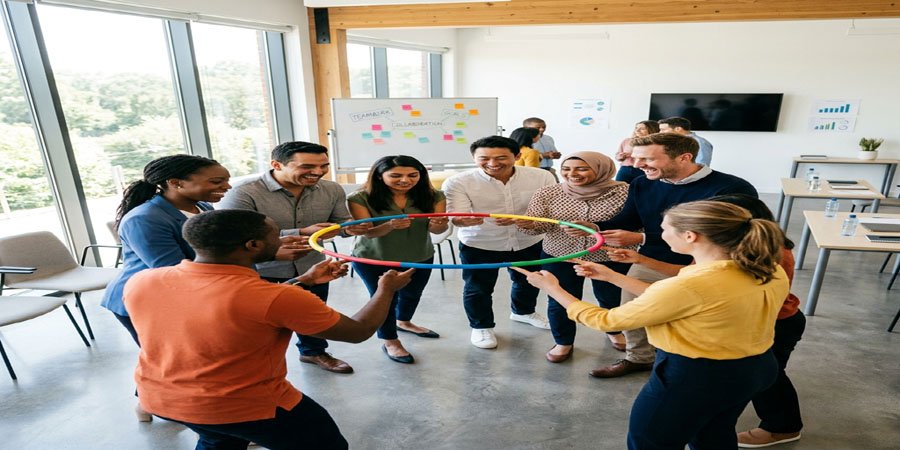
Do you want to conduct the Hula Hoop Game with your teams?
This activity is built on experiential learning, where people learn by doing rather than only listening. It also draws from group dynamics, because participants must coordinate movement, timing, communication, trust, and shared attention. The exercise helps people notice how roles emerge under light pressure, such as who gives direction, who supports others, who adapts, and who stays quiet. It works well because a simple prop creates a clear challenge that reveals real patterns in collaboration.
In this article, let’s see how you can conduct this activity with your teams.
Here is an overview of the sections in this article:
- Objective of the Activity
- 5 Variations of the Hula Hoop Game
- Tips for Successful Facilitation
- Frequently Asked Questions about the Exercise
So, let’s get started!
Objective of the Activity
The Hula Hoop Game gives participants a hands-on way to practice communication, coordination, and shared problem-solving. It turns a simple physical task into a useful learning moment for workplace teams, student groups, leadership programs, and training sessions.
Here are the key objectives you can focus on during this exercise.
Strengthening Clear Communication
This exercise helps participants see how small messages affect the whole task. When people speak at the same time, use vague words, or miss key details, the challenge becomes harder. Clear communication improves when participants slow down, listen fully, and give short instructions. The activity shows that good teamwork depends on simple language, active listening, shared timing, and mutual awareness.
Building Trust Under Pressure
Participants must rely on each other to complete the task without blaming anyone for mistakes. Since each person has a role, one weak connection can affect the final result. This creates a safe way to explore trust during pressure. People learn that patience, support, and calm reactions help the whole team recover faster when the plan does not work right away.
Revealing Leadership and Team Roles
The exercise often shows natural leadership patterns within minutes. Some people guide the process, some observe, while others follow instructions or encourage peers. These roles are not fixed, yet they reveal how people behave during shared challenges. A good facilitator can use the debrief to help participants reflect on leadership balance, inclusion, voice, and how roles shift when conditions change.
Improving Coordination and Focus
The task requires people to move with care while staying aware of the full team. One person moving too fast can disrupt everyone else, so participants must match their pace. This builds group focus in a practical way. The activity also helps people understand how timing, patience, body language, and shared goals can make coordination smoother in real work situations.
Encouraging Problem-Solving Through Practice
The challenge gives participants a chance to test ideas quickly. They can try one method, notice what happens, adjust, then try again. This simple cycle supports practical problem-solving without long discussion. It also reminds participants that improvement often comes from small changes, not perfect plans. The exercise works best when teams learn from attempts rather than treating mistakes as failure.
5 Variations of the Hula Hoop Game
Here are 5 variations of the Hula Hoop Game for your teams.
#1. Classic Lower the Hoop
This classic version asks participants to lower a hoop from shoulder height to the floor while keeping contact with their index fingers. The task looks easy at first, yet it quickly reveals issues with timing, pressure, assumptions, and communication.
Time: 10-20 minutes
Materials: Hula Hoop
Participants: 3-8 people per group
Instructions
- Team members should form a circle and extend both index fingers at chest height; everyone should be ready before starting.
- Rest the hoop lightly on everyone’s index fingers, then explain that each finger must maintain contact throughout the game.
- Lower the hoop together as a team, avoiding gripping or hooking; if any finger loses contact during the descent, reset and begin again.
- The hoop must reach the floor with all fingers still touching at the end; teams that do so successfully complete the activity and celebrate progress together.
Our Experience While Running This Activity: We initially found that everyone tried to control the hoop at the same time, which made it move in unexpected directions. We learned that agreeing on a simple pace and communication approach before starting made the task much smoother.
Debrief
- What made the task harder than it first appeared?
- How did your team decide who would guide the process?
- What communication habit helped you make progress?
You can also read:
50 Awesome Team Building Activities (Workplace)
#2. Silent Circle Challenge
In this version, participants complete the same lowering task without speaking after the first planning minute. The silence forces them to use eye contact, gestures, body movement, and patience to stay aligned.
Time: 10-20 minutes
Materials: Hula Hoop and Timer
Participants: 3-8 people per group
Instructions
- Allow each team one minute to plan their approach before silence begins.
- Once ready, have everyone place their index fingers under the hoop at chest height, ensuring contact is maintained throughout.
- With the timer running, teams lower the hoop to the floor without speaking; any spoken word or broken contact means a reset and another try.
- The game concludes when a team lowers the hoop completely in silence, all fingers touching at the finish; all teams who succeed are acknowledged.
Debrief
- What did silence reveal about how your team normally communicates?
- Which nonverbal signals were most helpful during the challenge?
- How did your team handle confusion without speaking?
#3. One Leader Rotation
This version gives one person at a time the role of caller during the activity. The caller can guide the pace, yet everyone else must still stay engaged, focused, and responsible for the result.
Time: 10-20 minutes
Materials: Hula Hoop and Timer
Participants: 3-8 people per group
Instructions
- Assign one participant as the caller to lead the group with verbal instructions for one minute while others follow their guidance.
- Lower the hoop together under the caller’s direction, ensuring every finger maintains contact throughout the descent—no gripping or hooking.
- After each minute, select a new caller so everyone leads at least once, moving through the group in a set order.
- The task is complete when the hoop rests on the floor with all fingers still touching; if successful, the whole group achieves the goal and the round concludes.
Debrief
- How did the team respond to different leadership styles?
- What changed when you became the caller?
- How can shared leadership support better results at work?
#4. Obstacle Path Transfer
This variation adds a short movement path after the team lifts the hoop from the floor. Participants must carry it across a marked route while keeping finger contact, which adds planning, balance, and careful pacing.
Time: 10-20 minutes
Materials: Hula Hoop, Cones, and Tape
Participants: 3-8 people per group
Instructions
- Mark a short path on the floor using cones or tape, with one or two turns or obstacles along the way.
- Have participants place their index fingers under the hoop and lift it to a comfortable height.
- Ask the team to walk together through the entire path while keeping the hoop balanced on their fingers.
- If anyone loses contact with the hoop, have the team return to the starting point and try again. The challenge is complete when they reach the finish line without losing contact.
What Worked for Us While Running This Activity: We found that teams had to pay much more attention to their pace once movement and turns were added to the challenge. Slowing down at the obstacles made coordination easier and highlighted how one person’s movement could affect the whole group.
Debrief
- What planning choices helped your team move through the path?
- How did the added movement change the way you worked together?
- Where did your team need more patience or coordination?
#5. Countdown Cooperation
This version adds a time limit, which creates urgency while keeping the challenge safe. Participants must balance speed with control, showing how pressure can improve focus or create avoidable mistakes.
Time: 10-20 minutes
Materials: Hula Hoop and Timer
Participants: 3-8 people per group
Instructions
- Each team practices lowering the hoop together for two minutes, focusing on steady, continuous movement.
- Set a countdown timer for three to five minutes based on comfort level, then announce the official timed challenge.
- Teams must lower the hoop to the floor with all fingers in contact before the timer ends; if anyone loses contact, pause and restart from the beginning.
- The game ends when a team completes the challenge within the time limit, with every finger touching the hoop on the ground; those who finish in time are recognized for meeting the goal.
Debrief
- How did the countdown affect your team’s behavior?
- What helped your team stay calm while working quickly?
- How can your team manage time pressure more effectively in real tasks?
Want to Develop Leaders at Every Level of Your Organization?
If you want a practical system to develop leaders at all levels, get this master guide and apply our proprietary ZIGN Framework™ of Leadership:
Looking for Unique Team Building Activities?
If you want unique activities that help your workforce grow through every stage of team development, get this guide:
Need Fresh Team Building Activities Every Month?
If you are a busy leader, get 5 unique, fully customizable activities every month—no preparation or trainer required.
Tips for Successful Facilitation
A simple activity can produce strong learning when you frame it well. Your role is to create structure, protect psychological safety, observe patterns, and guide reflection without taking over the task.
Use these tips to make the exercise smoother, safer, and more meaningful.
Set Clear Rules Before Starting
Explain the task in plain language before anyone touches the hoop. Show the required finger position, contact rule, reset rule, and finish point. Keep your directions short so participants can begin quickly. If people debate the instructions, repeat the goal rather than solving the challenge for them. Clear rules reduce confusion, yet they still leave enough space for teamwork, creativity, and trial-based learning.
Watch Behavior Without Interrupting Too Much
Once the activity begins, step back and observe. Notice who speaks first, who stays quiet, who checks on others, and how people react when the hoop rises instead of lowers. Avoid correcting every issue unless safety is at risk. The best insights often come from struggle. Your notes will help you ask sharper debrief questions later, which makes the learning feel grounded in what actually happened.
Keep the Mood Light and Safe
This exercise can create laughter, surprise, and mild frustration. Make it clear that the task is not a test of intelligence or physical skill. Participants should feel free to try, fail, reset, and try again. If someone becomes embarrassed, normalize the difficulty. A light tone helps people stay open. Safety also includes making space for different mobility levels, comfort levels, and communication styles.
Connect the Activity to Real Work
The debrief matters more than the prop. After the challenge, help participants connect what happened to meetings, projects, handoffs, deadlines, and leadership moments. Ask how small actions affected the whole result. Invite examples from their daily work, such as unclear ownership or too many voices at once. This turns a short game into a practical lesson that people can remember later.
Adapt the Challenge to the Room
Choose the variation that fits your setting, time, and participant energy. A new team may benefit from the classic version, while an experienced team may need silence, timed pressure, or rotating leadership. Adjust the height, rules, or path if space is limited. Keep the core lesson intact: people must coordinate to succeed. Good facilitation means matching the challenge to the learning goal, not forcing one format.
Final Words
The Hula Hoop Game is simple to set up, yet it can create deep conversations about teamwork, leadership, communication, and trust. It works because people experience the challenge first, then reflect on what their behavior showed. You can use the classic format or choose a variation that fits your training goal. The key is to keep the rules clear, watch the process closely, and give enough time for a thoughtful debrief. Try it in your next session, then ask participants what the hoop revealed about how they work together.
FAQ: Hula Hoop Game
You might have these questions in mind.
What is the main purpose of the Hula Hoop Game?
The main purpose is to help participants practice teamwork through a simple physical challenge. It shows how communication, coordination, trust, and leadership affect shared results. Because the task is easy to understand, people can focus on behavior rather than complex rules. The learning comes from what happens during the attempt, then from the discussion that follows after the activity ends.
How long does the activity usually take?
Most versions take 10 to 20 minutes, including instructions, practice, the main attempt, and a short debrief. If you want a deeper discussion, allow another 10 minutes for reflection. The activity is flexible, so you can shorten it for a quick energizer or expand it for a team development session. Time depends on group size, variation, and learning goals.
How many people should join each group?
A good size is 3 to 8 people per group. Smaller groups finish faster, while larger ones create more communication challenges. If you have many participants, split them into several groups so everyone stays active. Avoid making one circle too crowded, because participants need space to move safely. The ideal number gives everyone a clear role in the task.
Can this exercise work with remote teams?
The standard version works best in person because participants need shared physical contact with the hoop. For remote teams, you can adapt the learning goal with a virtual coordination task, such as timed drawing, shared puzzle solving, or silent instruction rounds. Keep the same focus on communication, roles, pressure, and reflection. The prop may change, but the teamwork lesson can remain useful.
What should facilitators avoid during the activity?
Facilitators should avoid overexplaining, rescuing the team too soon, or turning the task into a competition that feels stressful. Do not shame participants when the hoop moves the wrong way. That moment often creates the best learning. Also avoid skipping the debrief, because the discussion connects the experience to real work. Keep the space supportive, clear, and focused on growth.
Like this article on the “Hula Hoop Game”? Feel free to share your thoughts.
