Do you want to conduct the Helium Stick Activity with your teams?
The Helium Stick is a well-known group exercise designed to highlight core dynamics of teamwork. It looks deceptively straightforward, but it quickly reveals how even small tasks require a high degree of collaboration, clear communication, and adaptability.
In this article, let’s see how you can conduct this exercise with your teams.
Here is an overview of the sections in this article:
- The primary objectives of the Helium Stick Game.
- Five different variations of the activity, including the classic version.
- Tips to ensure a successful session for everyone.
- A comprehensive FAQ section addressing common questions and challenges.
Objective of the Activity
The Helium Stick activity is more than just a group game. It provides a mirror for examining how teams function in practice. This powerful experiential exercise introduces fundamental challenges found in real-world collaboration.
Here are the key objectives of this activity, explored in detail.
Enhancing Communication
The Helium Stick exercise draws attention to both spoken words and nonverbal signals. As groups try to lower their stick, members notice how ambiguous directions and overlapping instructions can actually hinder progress. Participants see how easily misunderstandings happen, highlighting the need for clear communication.
Fostering Collaboration
No single participant can complete this task alone. Helium Stick is a team challenge because any drop, break in contact, or solo effort derails the process. Instead, the activity demands synchronous movement and real-time adjustments. As teams succeed or fail together, individuals quickly see the value of shared responsibility and joint effort.
Developing Problem-Solving Skills
The first attempt almost always ends in confusion—why is it so hard to bring the stick down when everyone is trying? This puzzle encourages critical thinking and prompts teams to pause, observe patterns, and change tactics on the fly. Problem-solving can mean devising a new strategy, like adjusting grip or having everyone move in tiny, measured steps.
Identifying Leadership
The activity naturally reveals different leadership styles. Some participants take charge, suggesting new approaches, while others focus on building consensus. Leadership roles might shift as the activity progresses, revealing that it’s not just about titles, but about how people behave and communicate.
Building Patience and Focus
Helium Stick asks for more than just quick action; it requires sustained patience. The stick’s tendency to rise instead of fall can be baffling and, at times, irritating. Teams must resist the urge to rush. The repeated instruction to keep fingers in contact tests focus, especially when small mistakes force a restart.
5 Variations of the Helium Stick Activity
Here are 5 variations of the Helium Stick activity, each designed to introduce new challenges and insights into team dynamics. Try a mix of these to keep the experience fresh and stimulate new learning moments.
#1. The Classic Helium Stick
This is the original version that team facilitators have used for decades. Simple, direct, and surprising, it’s ideal for first-timers and experienced groups alike.
Time: 10-20 minutes
Materials: One lightweight stick (such as a tent pole, broomstick, or thin PVC pipe) per group
Participants: 3-8 people per group
Instructions
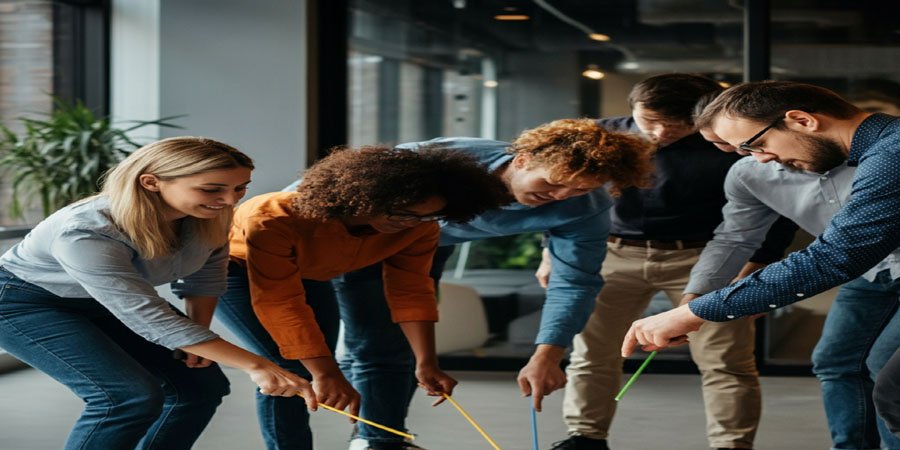
- Ask each team to stand in two lines facing one another, about an arm’s length apart.
- Instruct participants to hold their index fingers out, keeping hands waist-high. Place the stick across their extended fingers for everyone to support.
- Announce that the challenge is to lower the stick to the ground without losing anyone’s finger contact. For instance, if any person’s finger loses contact—even for a moment—the facilitator asks the team to restart.
- Watch as the stick often floats upward due to everyone subconsciously pushing up, even though the task is to go down.
Debrief
- What was your initial reaction when the stick started to rise?
- How did your team’s communication change as the activity progressed?
- What leadership behaviors did you observe within the group?
#2. The Blind Balance
Add a sense of unpredictability by removing the ability to see. Relying exclusively on clear, verbal guidance takes collaboration to a new level.
Time: 10-20 minutes
Materials: One lightweight stick and blindfolds for half the participants per group
Participants: 3-8 people per group
Instructions
- Set up the team facing each other, as in the classic variation.
- Ask half the team—only members on one side—to put on blindfolds while the others remain unblindfolded.
- The sighted participants are responsible for directing their blindfolded partners, using words and short phrases to describe each step. For example, “lower your right hand two inches” can help coordinate tiny adjustments.
- Continue to enforce the rule: all fingers must stay in contact with the stick, or the team restarts.
Debrief
- How did being blindfolded (or guiding someone who was) change your experience?
- What communication strategies were most effective in this version?
- What did this activity teach you about trust within a team?
#3. The Silent Stick
Take language away—watch teamwork become even more challenging. This version is a favorite for highlighting how much we rely on words.
Time: 10-20 minutes
Materials: One lightweight stick per group
Participants: 3-8 people per group
Instructions
- Form two lines with the group, maintaining arm’s length as in the classic version, and balance the stick across everyone’s extended index fingers.
- Announce that no participant may speak, make sounds, or use words during the activity.
- Participants must figure out how to coordinate movement exclusively with eye contact, facial expressions, or hand gestures. For instance, someone might nod slowly or flatten their palm to signal everyone to lower together.
- Any violation of the silent rule means the group starts over, reinforcing the importance of nonverbal communication.
Debrief
- How did the restriction on speaking affect your team’s ability to coordinate?
- What non-verbal signals did your group find most useful?
- What did you learn about the importance of non-verbal communication in teamwork?
#4. The Maze Movers
Elevate the challenge with an environment that requires navigation and a flexible team plan. This version draws out creative problem-solving.
Time: 10-20 minutes
Materials: One lightweight stick and several small obstacles (like cones, chairs, books, etc.)
Participants: 3-8 people per group
Instructions
- Arrange cones, chairs, or other small items into a gentle obstacle course in the group’s path.
- Ask everyone to lift the stick, using the classic setup, and then assign the task of carrying the stick through the obstacle course while keeping all fingers touching. If the stick drops or someone loses contact, the group starts at the beginning.
- As the group works, they must collectively decide how to maneuver. For example, one person leading might whisper, “turn left slightly” or use a hand signal to gain consensus for shifting direction.
- After navigating the course, the group lowers the stick to the ground at the end.
Debrief
- What was the most challenging part of navigating the obstacles as a team?
- How did your group plan your path through the course?
- What does this exercise show about planning and execution in complex projects?
#5. The One-Handed Stick
In this version, limit each participant’s grip to a single finger, increasing the challenge. Expect more trial, error, and laughter.
Time: 10-20 minutes
Materials: One lightweight stick per group
Participants: 3-8 people per group
Instructions
- Ask the team to stand in a circle, rather than two lines, so every person surrounds the stick equally spaced apart.
- Each person uses only one index finger to support the stick, with hands under the stick and palm down. No thumbs, no extra fingers—just one.
- Everyone must lower the stick to the ground, keeping only that one finger in contact at all times. For instance, if the stick tilts, the team must slow down and communicate through eye contact.
- If any participant loses contact or switches fingers, the team must restart.
Debrief
- How did using only one hand change the difficulty of the task?
- What adjustments did your team have to make compared to the classic version?
- What did this activity reveal about the impact of individual contributions on a group goal?
Want Some Unique Leadership Development Activities?
If you want some unique activities to equip your employees (both in-person and virtual) with leadership skills, qualities, and mindset, you can get my premium e-book:
Or Want Some Unique Team Building Activities?
If you want some unique activities for your employees (both in-person and virtual), you can get my premium e-book:
Tips for Successful Facilitation
A successful Helium Stick activity hinges on the facilitator’s skill. The right setup creates a psychologically safe space where challenges become learning moments.
These tips help you ensure each participant gains insight and enjoys the process.
Set the Stage Properly
Begin by framing the activity as a collaborative exploration, not a test. Tell participants that the task has no right answer and that even groups of experts find it tricky at first. Share that everyone’s input matters. For example, preview that the stick may seem to “float” at the start and that’s expected. Setting this expectation reduces pressure and helps participants approach the challenge with curiosity.
Emphasize the Rules Clearly
Articulate every rule clearly before you begin. Say, “If any finger loses contact, we’ll restart” so the group focuses on precision. As a facilitator, check in with each group before they start to confirm everyone understands the rules and feels comfortable. If the group gets stuck or confused, clarify the instruction instead of solving the problem directly. Clear rules shape the environment and reflect real-world workplace boundaries.
Observe Without Intervening
Stand back as the activity unfolds. Resist the urge to “fix” things when the group struggles. Instead, watch carefully so you can tailor feedback later. Track patterns—who emerges as a leader, who steps back, who notices when fingers lose contact, and who encourages others. Take notes if helpful. In debrief, you can reference what you saw: “I noticed that when the stick drifted up, Chris suggested pausing. How did that change things?”
Manage Frustration
Expect groups to feel a bit frustrated, especially when they must restart. Normalize this experience. Let them know that working through setbacks is a core part of the activity. If tension rises, allow a brief pause for discussion. Ask, “What’s getting in the way?” Encourage the group to experiment with new approaches. Draw parallels to work life, where frustration signals a chance to rethink the approach.
Lead a Thoughtful Debrief
End each activity with a debrief—it’s where real learning happens. Ask open questions that connect the game to daily work, such as “When did your team work best together?” and “What small adjustments made the biggest difference?” Encourage team members to share their experience using examples from the activity. This helps them reflect on what worked, what didn’t, and what they can improve.
Final Words
The Helium Stick activity makes teamwork visible, memorable, and actionable. Even simple tasks become complex in a group setting, revealing patterns we miss in the rush of day-to-day work. With patience, groups learn to shift frustration into curiosity and chaos into alignment. By practicing this activity, participants build habits for open dialogue, mutual trust, and shared achievement. Take those lessons beyond the game; they serve every team’s mission.
FAQ: Helium Stick Activity
You might have these questions in mind.
What is the main point of the Helium Stick activity?
The core point of Helium Stick is to highlight challenges in group coordination, especially under constraints. Teams realize that communicating clearly and synchronizing movements—no matter how small—can make a big difference in results. The activity becomes a living metaphor for complex projects where individual efforts must add up exactly right. Participants leave with new insight into how their actions affect whole teams.
Why does the stick go up?
The stick rises because each member tries earnestly to maintain finger contact, unconsciously pushing upward. When all participants apply even slight upward pressure, the combined force is more than the stick weighs. That’s why it seems to “float” instead of dropping like you might expect. This surprising result quickly grabs attention and forms the foundation for reflecting on group dynamics.
Can this activity be done virtually?
The Helium Stick activity, as described, requires physical presence, touch, and real-time adjustments among group members, making an exact virtual replication tough. Virtual teams won’t get the same tactile experience. However, facilitators can use similar virtual games requiring timing, coordination, and group decision-making—like online drawing activities or virtual escape rooms—to simulate some of the same lessons. If you need ideas for remote adaptations, many resources are available.
What if a group gives up?
If a team wants to throw in the towel, treat it as a learning opportunity. Ask, “What made this feel impossible?” Acknowledge that frustration is part of group projects, and explore how resilience or creative problem-solving might help teams respond to tough moments. Discuss similar workplace situations where a fresh approach or step back helped a group push through a challenge. Making the conversation safe, honest, and supportive encourages long-term growth.
Is it suitable for all teams?
Nearly any team can benefit from Helium Stick, whether they are new or highly experienced. For groups that work remotely most of the time, use this activity as a special event during face-to-face meetings. If some participants have limited mobility, adapt the setup so everyone can participate with comfort and confidence—use a table, adjust height, or choose another light object. Tailoring the activity ensures everyone gains maximum value, reinforcing inclusivity and engagement for all.