
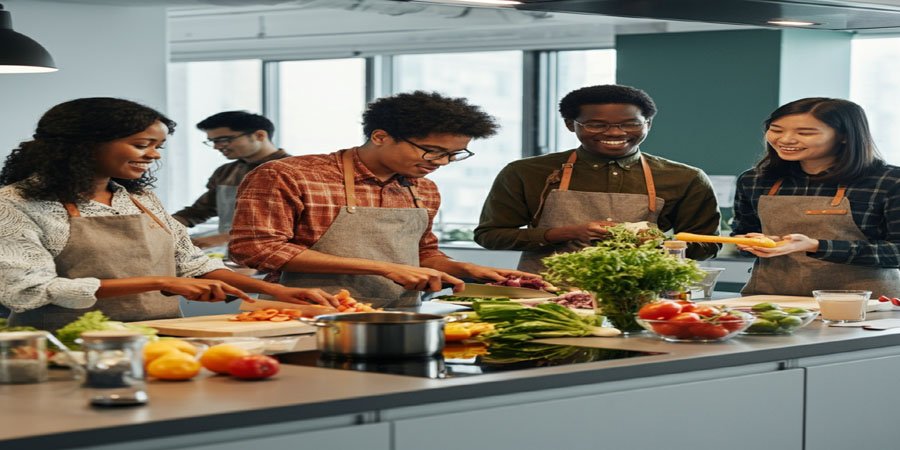
Do you want to conduct the cooking challenge with your teams?
Group activities are powerful tools for strengthening workplace relationships. A cooking challenge, grounded in experiential learning, pushes teams to collaborate under pressure. This shared experience helps members discover new things about each other, fostering trust, communication, and creative problem-solving. This activity creates a dynamic environment where roles emerge naturally.
In this article, let’s explore how you can conduct this activity with your teams.
Here is an overview of the sections in this article:
- The primary objectives of the activity.
- Five distinct variations of the cooking challenge.
- Tips for successful facilitation.
- Frequently asked questions.
Objective of the Activity
The cooking challenge is designed to be more than just a fun break from the usual work routine. It’s a strategic exercise with specific developmental goals for your team. This activity encourages participants to step outside their defined roles, offering a unique platform to practice essential soft skills in a low-stakes, high-energy setting.
Here are the key objectives of this engaging exercise.
Enhances Collaboration
Participants must work together closely to succeed. They need to combine their skills, manage tasks, and coordinate their efforts to produce a cohesive final dish. This requires shared responsibility, active listening, and a unified approach to reaching a common goal.
Fosters Creative Problem-Solving
Teams often face unexpected hurdles, such as limited ingredients, time constraints, or equipment challenges. They must think on their feet, adapt their plans, and devise innovative solutions together. This process strengthens their ability to tackle unforeseen problems in any project.
Improves Communication
Clear communication is vital for success. Team members must articulate their ideas, delegate tasks effectively, and provide constructive feedback throughout the challenge. The activity provides a practical space for honing both verbal and non-verbal communication skills under light pressure.
Builds Trust and Rapport
Working together in a new, informal setting helps break down barriers. Team members get to see different sides of their colleagues, building personal connections that translate back to the workplace. Shared success in the kitchen builds mutual respect and a stronger sense of camaraderie.
Highlights Leadership and Roles
Within the challenge, natural leaders often emerge. Participants may take on different roles based on their strengths, such as organizer, creative director, or timekeeper. The activity allows team members to practice leadership skills and observe how the group organizes itself to achieve its objective.
5 Variations of the Cooking Challenge
Here are 5 variations of the cooking challenge you can adapt to your team’s needs and resources.
#1. The Classic Cook-Off
This is the foundational version of the cooking challenge where teams are given identical sets of ingredients and a recipe. The primary goal is to execute the given recipe as skillfully and creatively as possible within the time limit.
Time: You decide
Materials: A set of identical ingredients per team, basic cooking utensils, a simple recipe, and a judging scoresheet
Participants: 3-8 people per group
Instructions
- Provide each team with the same recipe and a box containing all necessary ingredients.
- Explain the rules, time limit, and judging criteria, which could include taste, presentation, and teamwork.
- Ask each team to create the dish according to the recipe, allowing for creative twists in plating or seasoning. For instance, a team might choose to deconstruct the elements for a modern presentation.
- At the end of the time, have each team present their dish for judging and tasting.
Debrief
- How did your team delegate tasks to complete the dish on time?
- What was the most challenging part of working with these specific ingredients?
- If you could do this challenge again, what would your team do differently?
You can also read:
50 Easy Team Building Activities (Workplace)
#2. The Mystery Box Challenge
This variation adds an element of surprise and boosts creative thinking. Teams receive a box of mystery ingredients and must invent a dish from scratch without a recipe.
Time: You decide
Materials: A unique set of mystery ingredients for each team, a pantry of basic staples (like oil, salt, flour, etc.), and cooking equipment
Participants: 3-8 people per group
Instructions
- Give each team a box with a variety of ingredients, some of which might be unusual or seemingly mismatched.
- Instruct the teams to brainstorm and create a cohesive dish using only the items in their box and the common pantry. For example, a box with chicken, pineapple, and bell peppers might inspire a stir-fry or kebabs.
- Set a timer and let the teams begin cooking, encouraging them to be as innovative as possible.
- Have each team present their unique creation, explaining their concept and thought process to the judges.
Debrief
- How did your team decide on a dish with the mystery ingredients?
- Which ingredient posed the biggest creative challenge for your group?
- What communication strategies did you use when creating a plan from scratch?
#3. The Recipe Relay
This version focuses on communication and coordination under pressure. Only one team member at a time can work on the dish, with each person adding their contribution in short, timed intervals.
Time: You decide
Materials: A moderately complex recipe, all necessary ingredients, and cooking utensils
Participants: 3-8 people per group
Instructions
- Give the full recipe to only one person on each team, who acts as the guide but cannot cook.
- Have team members take turns working on the dish in two-minute shifts. During their shift, they can only receive instructions from the guide.
- At the end of each two-minute interval, the active cook must stop immediately, and the next person tags in. For instance, one person might chop vegetables, and the next one starts sautéing them.
- The relay continues until the dish is complete or time runs out.
Debrief
- How did the staggered instructions affect your team’s workflow?
- What was the most difficult part of handing over your task to the next person?
- How did the guide adapt their communication style for different team members?
#4. The No-Bake Dessert Challenge
This is a great option if you have limited kitchen facilities or want a simpler, less messy activity. Teams create a delicious dessert without using any ovens or stovetops.
Time: You decide
Materials: A variety of ingredients like cookies, fruits, yogurt, chocolate, and cream cheese
Participants: 3-8 people per group
Instructions
- Set up a “dessert bar” with a wide array of no-bake ingredients for teams to choose from.
- Challenge each team to create the most impressive dessert based on taste and presentation.
- Encourage them to invent a unique dessert concept and a name for their creation. For example, a team might make a layered parfait using crushed cookies, yogurt, and fresh berries.
- Teams present their desserts, and a tasting session determines the winner.
Debrief
- How did your team brainstorm ideas with the available ingredients?
- What role did presentation play in your team’s final dessert?
- How did your team balance individual creative ideas with the group’s final decision?
#5. The One-Handed Challenge
This variation emphasizes interdependence and precise communication. Team members work in pairs, and each person is only allowed to use one hand, forcing them to coordinate every action.
Time: You decide
Materials: A simple recipe (like making a sandwich or a salad), all ingredients pre-portioned, and basic utensils
Participants: 4-8 people per group (working in pairs)
Instructions
- Ask team members to form pairs and stand side-by-side.
- Instruct each person to place one arm behind their back, leaving one free hand to work with.
- Challenge each pair to complete a simple culinary task, such as making a gourmet sandwich or assembling a complex salad. For instance, one person might hold the bread steady while the other spreads the mayonnaise.
- The first pair to successfully complete the task wins.
Debrief
- How did you and your partner communicate to coordinate your movements?
- What was the most frustrating moment, and how did you overcome it together?
- What did this exercise teach you about relying on a teammate?
Want Some Unique Leadership Development Activities?
If you want some unique activities to equip your employees (both in-person & virtual) with leadership skills, qualities, and mindset, you can get my premium e-book:
Or Want Some Unique Team Building Activities?
If you want some unique activities for your employees (both in-person & virtual), you can get my premium e-book:
Tips for Successful Facilitation
A successful cooking challenge depends on good planning and thoughtful facilitation. Your role is to create an environment where teams can thrive and learn. A well-organized event ensures that participants focus on collaboration and creativity rather than logistical issues.
Here are some tips to help you run a smooth and impactful cooking challenge.
Prepare the Space and Materials
Before the activity begins, ensure all cooking stations are clean, organized, and equipped with the necessary tools. Portion out ingredients for each team to guarantee fairness and reduce chaos. Having everything ready allows teams to start the challenge immediately, maintaining energy and focus from the beginning. A messy or incomplete setup can cause delays and frustration.
Set Clear Expectations and Rules
Clearly explain the objective, rules, time limits, and judging criteria at the start. Let everyone know what is expected of them, including safety guidelines for handling knives or hot surfaces. A clear framework helps prevent confusion and ensures the competition is fair. When participants understand the goals, they can better strategize and work together effectively.
Emphasize Fun Over Competition
While the challenge is a competition, remind everyone that the primary goals are learning and connection. Encourage laughter, experimentation, and mutual support. Frame mistakes as learning opportunities, not failures. A lighthearted atmosphere reduces pressure, allowing team members to be more creative and open with one another. The focus should be on the shared experience.
Observe and Offer Minimal Guidance
Once the challenge starts, step back and observe the team dynamics. Watch how groups communicate, delegate tasks, and solve problems. Resist the urge to intervene unless there is a safety concern or a team is completely stuck. Your observations will be valuable for the debrief session, where you can provide specific, constructive feedback based on what you witnessed.
Facilitate a Meaningful Debrief
The debrief is the most important part of the activity. This is where the learning happens. Ask open-ended questions to guide a reflective conversation about the experience. Prompt teams to discuss what they learned about their communication, problem-solving, and teamwork. Help them connect these insights back to their day-to-day work, turning a fun activity into a lasting developmental tool.
Final Words
A cooking challenge for teams is an effective way to improve collaboration, communication, and creative problem-solving. This hands-on activity builds trust and reveals team dynamics in a practical, engaging setting. By adapting the challenge with different variations, you can tailor the experience to your team’s specific goals. The real value comes from the debrief, where teams reflect on their performance. Use these insights to foster a more connected and efficient work environment.
FAQ: Cooking Challenge
You might have these questions in mind.
What if my team members can’t cook?
The challenge is designed for all skill levels. The focus is on teamwork, communication, and problem-solving, not culinary expertise. Simple recipes or no-bake variations ensure everyone can participate and contribute successfully.
How can I run this activity for a remote team?
A virtual cooking challenge works well. Send each team member a list of ingredients to buy or a meal kit. Then, have everyone join a video call where they cook together in breakout rooms.
Is this activity safe for the workplace?
Yes, with proper precautions. Use simple recipes that minimize risks, such as no-bake challenges or tasks involving cold ingredients. If using knives or heat, start with a clear safety briefing and ensure proper supervision.
How do you judge the winner?
Judging criteria should be clear from the start. You can score teams on taste, presentation, creativity, and teamwork. Consider having a panel of judges or letting all participants vote for their favorite dish.
What is the ideal group size for this activity?
Small groups of 3 to 8 people work best. This size is large enough for diverse ideas but small enough to ensure everyone can actively participate. If you have a larger department, divide it into smaller teams.