
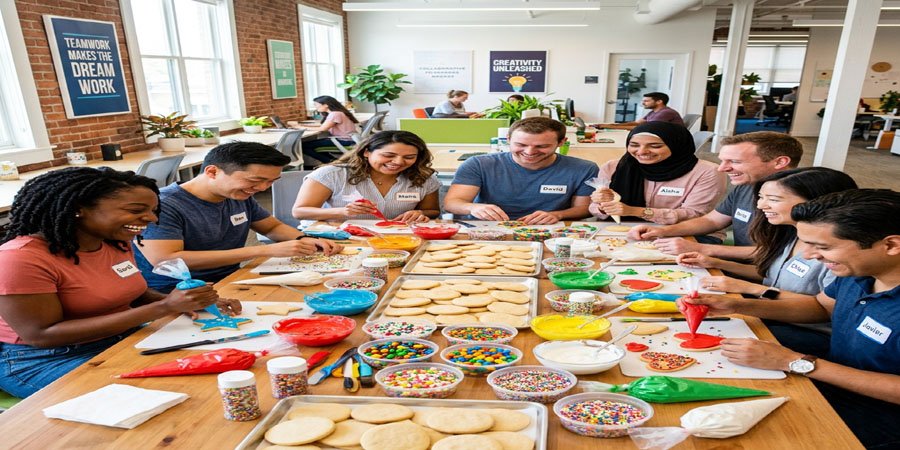
Do you want to conduct the cookie decorating team building activity?
This fun exercise blends creativity, communication, shared focus, and light problem-solving in one short session. It gives people a low-pressure way to express ideas while working beside others toward a simple goal. Hands-on tasks like this can reduce stress, spark conversation, and help coworkers connect in a natural setting. It also supports inclusion because people can join in at different skill levels without needing special training.
In this article, let’s see how you can conduct this activity with your teams.
Here is an overview of the sections in this article:
- Objective of the Activity
- 5 Variations of the Cookie Decorating Team Building Activity
- Tips for Successful Facilitation
- Frequently Asked Questions about the Exercise
So, let’s get started!
Objective of the Activity
This exercise is more than a fun break in the workday. It can help coworkers interact in a relaxed way while practicing useful workplace habits.
Below are the main outcomes you can aim for during this session.
Build Better Communication
People often talk more freely when they are doing something with their hands. Decorating cookies creates a casual setting where coworkers can share ideas, ask for help, give suggestions, and laugh together. This type of low-stakes interaction can improve comfort between people who do not usually speak much at work. Over time, that comfort can support clearer communication in meetings, projects, and daily tasks.
Encourage Creative Thinking
A plain cookie becomes a small canvas. Participants need to choose colors, shapes, themes, and design styles in a short amount of time. That process helps them think in new ways and make quick creative decisions. Creative confidence built in simple sessions can carry over into work tasks that need fresh ideas, flexible thinking, or a new angle on a challenge.
Strengthen Social Connection
Shared experiences help people feel closer. When coworkers decorate treats together, they often tell stories, joke around, and notice one another’s styles and preferences. These small moments matter because they build trust in a natural way. A stronger social bond can make collaboration smoother, especially when work becomes busy or stressful.
Practice Collaboration Under Light Pressure
Even a simple challenge can reveal how people plan, divide roles, and support one another. If the activity includes a shared design goal, coworkers may need to agree on a concept, manage time, and help finish details. That creates a mild form of teamwork without the weight of a work deadline. It is a useful way to observe collaboration habits in a fun setting.
Create Positive Energy
A short creative break can lift morale. People enjoy stepping away from routine tasks to do something playful, colorful, and edible. The activity can refresh energy during an offsite, meeting, celebration, or training day. When done well, it leaves people with a sense of enjoyment that can carry into the rest of the session.
5 Variations of the Cookie Decorating Team Building Activity
Here are 5 variations of the cookie decorating activity for your teams.
#1. Classic Cookie Decorating
This version invites participants to decorate individual cookies in any style they like within a short time limit. It is simple to run, easy to explain, and works well for most workplace settings.
Time: 10-20 minutes
Materials: Plain Cookies, Icing, Sprinkles, and Napkins
Participants: 3-8 people per group
Instructions
- Give each team a set of plain cookies, icing, and toppings. For example, each team may receive stars, circles, and heart shapes.
- Ask participants to decorate their cookies based on any theme they enjoy, such as holidays, company values, or favorite colors.
- Remind the team to manage time well so everyone can finish at least one complete design before the session ends.
- Invite each team to display their finished cookies for a quick sharing round at the end.
Our Experience While Running This Activity: We found that participants could spend too much time perfecting individual details when working under a time limit. Reminding everyone to complete a recognizable design before adding finishing touches helped them manage their time.
Debrief
- What did you notice about how people shared materials or ideas?
- Which decorating choices helped express personality most clearly?
- How did the relaxed setting affect your conversation?
You can also read:
50 Easy Team Building Activities (Workplace)
#2. Theme Challenge Cookie Round
In this variation, each set of participants decorates cookies around one assigned theme. The theme adds focus, which makes idea sharing more structured and often more lively.
Time: 10-20 minutes
Materials: Plain Cookies, Colored Icing, Sprinkles, Theme Cards, and Napkins
Participants: 3-8 people per group
Instructions
- Hand each group one theme card, such as celebration, nature, success, or kindness. For instance, a nature theme may inspire flowers, leaves, or sunshine designs.
- Ask the group to spend one minute agreeing on how they will interpret the theme before they start decorating.
- Encourage participants to create cookies that connect clearly to the shared idea while still showing personal style.
- End with a short gallery walk where each group explains how their designs match the assigned theme.
Debrief
- How did the theme shape your planning process?
- What helped your group reach ideas quickly?
- What did you learn from seeing other interpretations?
#3. Storytelling Cookie Set
This format asks participants to create a short visual story using multiple cookies. It works well when you want more discussion, imagination, and shared meaning.
Time: 10-20 minutes
Materials: Plain Cookies, Icing, Sprinkles, Markers, Index Cards, and Napkins
Participants: 3-8 people per group
Instructions
- Give each group several cookies and ask them to create a beginning, middle, and ending through decoration. For example, they might show a work challenge, a breakthrough, then a celebration.
- Invite participants to sketch a quick idea on an index card before they start decorating.
- Encourage the group to divide small roles, such as outlining, filling color, or presenting the story.
- Ask each group to present its cookie story in one minute after the decorating time ends.
Debrief
- How did your group turn ideas into a shared story?
- What part of the process felt easiest or hardest?
- How did storytelling affect cooperation?
#4. Mystery Materials Decorating
This version adds surprise by giving each set of participants a random mix of decorating supplies. The limited choice can spark resourcefulness, laughter, and quick adaptation.
Time: 10-20 minutes
Materials: Plain Cookies, Random Toppings, Colored Icing, Small Cups, and Napkins
Participants: 3-8 people per group
Instructions
- Prepare different supply packs in advance so each team gets a unique mix of toppings. For instance, one team may receive only blue icing, crushed candy, and silver sprinkles.
- Ask participants to use only the materials in their pack to create the best design they can.
- Encourage the team to discuss how to use limited supplies in smart ways before decorating begins.
- Invite each team to share what creative choices they made because of the restrictions.
Debrief
- How did limits affect your creativity?
- What strategies helped your team adapt fast?
- Where do you see similar situations at work?
#5. Collaborative Masterpiece Cookies
In this activity, participants work toward one connected visual idea across several cookies. It is a good choice when you want stronger coordination in a short period.
Time: 10-20 minutes
Materials: Plain Cookies, Icing, Sprinkles, Reference Sheet, and Napkins
Participants: 3-8 people per group
Instructions
- Ask each group to create one larger picture or message spread across several cookies. For example, they may design a skyline, logo-inspired pattern, or motivational phrase.
- Give the group one minute to assign who will decorate each piece before the work starts.
- Encourage participants to check alignment, colors, and spacing so the final set looks connected.
- At the end, have each group place its cookies together on a tray for a full reveal.
What We Learned While Running This Activity: We found that separately decorated cookies did not always look connected when placed together. Agreeing on colors and the overall design before starting helped create a more cohesive final display.
Debrief
- What helped your group stay consistent across the full design?
- How did you divide tasks during the challenge?
- What does this activity show about coordination in real work?
Want to Develop Leaders at Every Level of Your Organization?
If you want a practical system to develop leaders at all levels, get this master guide and apply our proprietary ZIGN Framework™ of Leadership:
Looking for Unique Team Building Activities?
If you want unique activities that help your workforce grow through every stage of team development, get this guide:
Need Fresh Team Building Activities Every Month?
If you are a busy leader, get 5 unique, fully customizable activities every month—no preparation or trainer required.
Tips for Successful Facilitation
A smooth session depends on more than cookies and icing. Good facilitation helps people feel comfortable, stay engaged, and leave with a positive memory.
Here are five useful tips to guide your session well.
Prepare Materials in Advance
Set everything out before participants arrive. Place cookies, icing, toppings, napkins, plates, and wipes where each group can reach them easily. Pre-sorted materials save time and reduce confusion during setup. If possible, test the supplies first so the icing flows well and the toppings are easy to use. A well-organized setup makes sure everyone can jump in right away without searching for missing items.
Keep Instructions Short
People should understand the task in less than two minutes. Use plain language, explain the goal, share the time limit, then repeat the final outcome expected from each group. Long explanations can drain energy before the fun begins. A clear example can help people start fast without overthinking the exercise. Clear, brief instructions spark interest right away and ensure everyone feels ready to join in.
Make the Setting Inclusive
Not everyone feels confident about artistic tasks. Remind participants that the goal is not perfection but participation, creativity, and connection. Encourage simple designs as much as detailed ones. You can also offer different roles, such as planner, decorator, presenter, or timekeeper, so everyone can contribute in a way that feels comfortable. Make sure every person feels welcome and valued, no matter their skill or experience level.
Manage Time with Care
A short activity works best when the pace feels light but focused. Tell participants when they have five minutes left, then give a one-minute warning before the end. These reminders help people wrap up without stress. Good time management also protects the debrief, which is often where the deeper value appears. When you stick to the planned schedule, everyone stays on track and the whole session runs without unnecessary pauses.
Lead a Meaningful Debrief
Do not skip the reflection piece. A few open questions can help people connect the fun experience to communication, creativity, flexibility, or collaboration at work. Keep the discussion brief yet purposeful. Invite several voices to share, then close with one practical takeaway that participants can carry into future teamwork. A thoughtful debrief locks in the key lessons, helping every person turn this creative activity into a useful learning moment they can bring back to the workplace.
Final Words
The cookie decorating activity is easy to run, enjoyable for most people, and useful for team connection. It brings creativity into the room without making the session feel heavy. With the right variation, you can match the exercise to your goal, time, and group size. A short debrief helps turn a playful moment into a meaningful learning experience. If you plan it well, this activity can leave your teams more relaxed, engaged, and connected.
FAQ: Cookie Decorating Team Building Activity
You might have these questions in mind.
How much time should this activity take?
Most versions can be completed in 10 to 20 minutes. That makes the exercise a good fit for meetings, workshops, offsites, or celebration events. If you want deeper reflection, add a few extra minutes for discussion after the decorating ends. Keep the decorating part short so the energy stays high.
What if some participants are not creative?
That is completely fine. This exercise works well because it does not require advanced artistic skill. Simple patterns, color choices, or themed ideas are enough to take part. A supportive facilitator can help everyone feel included by focusing on fun and shared effort.
Can this exercise support workplace learning?
Yes, it can. While the task feels light, it can highlight communication, planning, flexibility, and cooperation. The learning becomes clearer during the debrief, where participants reflect on what happened. With good questions, the activity can connect well to real workplace habits.
What materials should I prepare?
Start with plain cookies, icing, toppings, napkins, and a clean surface for decorating. You may also add theme cards, trays, wipes, gloves, or simple reference sheets depending on the variation. Try to prepare materials in equal sets so each group has a fair chance to participate. Organized supplies make the session run much better.
Is this suitable for small or large workplaces?
Yes, it can work in both settings. For smaller workplaces, everyone can decorate in one shared space with one facilitator. For larger workplaces, divide participants into smaller tables so the activity stays manageable. Clear setup and simple instructions will help the session run smoothly at any scale.
Like this article on the “Cookie Decorating Team Building Activity”? Feel free to share your thoughts.
