
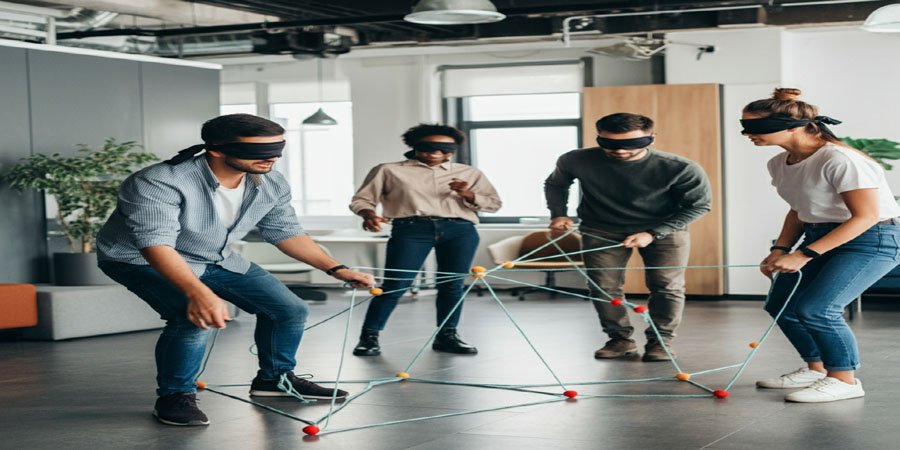
Do you want to conduct the Blind Polygon Game with your teams?
This activity is a classic communication exercise that challenges groups to work together under constraints. It highlights how teams handle limited information, differing perspectives, and the need for clear leadership. Participants must rely on verbal cues alone to achieve a common goal, making it a powerful tool for developing collaboration skills. This activity’s foundations lie in experiential learning, where teams learn by doing, reflecting, and applying lessons to real-world scenarios.
In this article, let’s see how to facilitate this engaging game with variations and debrief questions.
Here is an overview of the sections in this article:
- The primary objectives of the Blind Polygon activity.
- Five distinct variations of the game, including the classic version.
- Helpful tips for facilitating a successful session.
- Frequently asked questions about the game.
So, let’s get started!
Objective of the Activity
The Blind Polygon game is designed to improve team dynamics through a hands-on, collaborative challenge. By removing the sense of sight, the activity forces participants to depend entirely on their verbal skills, listening abilities, and trust in one another.
Here are the key objectives of the game.
Enhancing Communication
The primary goal is to highlight the importance of clear communication. Since participants are blindfolded, they cannot use visual cues like gestures or body language. They must learn to convey their ideas precisely, listen actively to others, and synthesize information from multiple sources to form a cohesive plan. This objective teaches teams the value of concise language, active listening, and confirming understanding to prevent mistakes.
Developing Leadership Skills
This activity provides a natural opportunity for leadership to emerge. A leader might surface to direct the group, organize the flow of information, or motivate the team. The game allows participants to practice different leadership styles in a practical setting. It can also show how a team functions with or without a designated leader, revealing the group’s capacity for self-organization.
Fostering Collaboration
Success in the Blind Polygon exercise is impossible without effective collaboration. Team members must work together, combining their individual perspectives to understand the bigger picture. The activity demonstrates how shared goals can be achieved when everyone contributes, supports each other, and works as a single unit. It encourages a sense of shared responsibility for the outcome.
Improving Problem-Solving Abilities
Faced with the challenge of creating a shape without sight, teams must devise a strategy. This requires creative thinking, planning, and adapting when the initial plan does not work. The activity strengthens the group’s problem-solving muscles by encouraging them to analyze the situation, brainstorm solutions, and implement a plan of action. Participants learn to approach complex problems methodically.
Building Trust
Trust is a crucial component of the exercise. Participants must trust their teammates to provide accurate information, listen to their suggestions, and execute their roles effectively. Placing a rope in a specific configuration while blindfolded requires faith in the collective effort. The shared experience of overcoming the challenge together can significantly strengthen bonds and build interpersonal trust within the team.
5 Variations of the Blind Polygon Game
Here are 5 variations of the Blind Polygon game you can try with your teams.
#1. The Classic Square
This is the standard version of the activity, where the team’s objective is to form a perfect square. It serves as an excellent introduction to the core concepts of communication and collaboration under constraints.
Time: 10-20 minutes
Materials: One long rope (at least 20-30 feet) with its ends tied together, and blindfolds for every participant
Participants: 3-8 people per group
Instructions
- Ask each team to stand in a circle and hold onto the rope, then put on their blindfolds.
- Instruct the teams that their task is to form a perfect square with the rope without removing their blindfolds.
- Allow the teams time to strategize, communicate, and manipulate the rope into the desired shape. For instance, they might try to create four equal sides and four right angles.
- Once a team believes they have successfully formed a square, ask them to place the rope on the ground and remove their blindfolds to see their result.
Debrief
- How did your team develop a strategy to create the shape?
- What communication methods worked well, and what could have been improved?
- Who emerged as a leader, and how did their leadership impact the group?
You can also read:
50 Easy Team Building Activities (Workplace)
#2. The Multi-Shape Challenge
This variation adds complexity by requiring the team to form a sequence of different geometric shapes. It tests the team’s adaptability and ability to manage more intricate instructions.
Time: 10-20 minutes
Materials: One long rope with its ends tied together, blindfolds for every participant, and a list of shapes (e.g., triangle, square, hexagon, etc.)
Participants: 3-8 people per group
Instructions
- Have each blindfolded participant hold onto the rope.
- Announce the first shape the team needs to create, such as a triangle.
- Once they complete the first shape, announce the next one without letting them remove their blindfolds. For example, after the triangle, ask them to form a pentagon.
- Continue with two or three different shapes, then have the group remove their blindfolds to see their final creation.
Our Experience While Running This Activity: We found that teams could become confused when they moved to the next shape before agreeing on the current one. Confirming the completed shape before changing the instructions helped maintain a shared understanding.
Debrief
- How did the challenge of creating multiple shapes change your team’s approach?
- What was the most difficult part of transitioning from one shape to another?
- How did your team ensure everyone understood the plan for each new shape?
#3. The Silent Director
In this version, only one person can speak, adding a layer of controlled communication. This variation emphasizes the importance of clear instructions from a single source and attentive listening from the rest of the team.
Time: 10-20 minutes
Materials: One long rope with its ends tied together, and blindfolds for every participant
Participants: 3-8 people per group
Instructions
- Before putting on blindfolds, ask the team to designate one person as the “Director.”
- Instruct the team that only the Director is allowed to speak once the activity begins.
- The blindfolded team, holding the rope, must follow the Director’s verbal commands to form a specific shape, for instance, a rectangle.
- The activity ends when the Director is satisfied with the shape, and the team can remove their blindfolds.
Debrief
- For the Director: What was challenging about giving instructions without receiving verbal feedback?
- For the team members: How did it feel to rely on a single person for all information?
- How did the team build trust in the Director’s instructions?
#4. The Open Rope
This variation changes a fundamental element of the game: the rope is not tied into a loop. This requires the team to manage two loose ends, presenting a new set of coordination challenges.
Time: 10-20 minutes
Materials: One long, untied rope, and blindfolds for every participant
Participants: 3-8 people per group
Instructions
- Have the blindfolded team spread out along the length of the untied rope.
- Inform them that their task is to create a specific open shape, such as the letter “S” or “M”.
- The team must coordinate to position the rope correctly, which includes managing the two ends. For example, they need to decide who holds the ends and where they should be placed.
- When the team agrees the shape is complete, they can remove their blindfolds to review their work.
A Small Adjustment We Made While Running This Activity: We found that participants could pull the loose ends in different directions when no one coordinated the movement. Agreeing on a common reference point and communicating before making adjustments helped the group work more systematically.
Debrief
- How did having an open rope change the communication needed to complete the task?
- What new challenges did managing the two ends of the rope introduce?
- What strategies did your team use to coordinate the placement of the entire rope?
#5. The Shape Within a Shape
This advanced variation requires the team to create two distinct shapes using one rope. It demands superior planning, coordination, and spatial awareness from the group.
Time: 10-20 minutes
Materials: One very long rope with its ends tied together, and blindfolds for every participant
Participants: 5-8 people per group
Instructions
- Instruct the blindfolded team, all holding the rope, that their objective is to form two shapes.
- Specify the task clearly. For instance, tell them to create a small triangle inside of a larger square.
- The team must figure out how to allocate people and sections of the rope to form both shapes simultaneously.
- After they agree the shapes are complete, have them place the rope on the ground and take off their blindfolds.
Debrief
- How did your team plan the division of labor to create two shapes at once?
- What was the most complex part of coordinating this task?
- Did your team’s initial strategy work, or did you have to adapt it? If so, why?
Want to Develop Leaders at Every Level of Your Organization?
If you want a practical system to develop leaders at all levels, get this master guide and apply our proprietary ZIGN Framework™ of Leadership:
Looking for Unique Team Building Activities?
If you want unique activities that help your workforce grow through every stage of team development, get this guide:
Need Fresh Team Building Activities Every Month?
If you are a busy leader, get 5 unique, fully customizable activities every month—no preparation or trainer required.
Tips for Successful Facilitation
Facilitating the Blind Polygon game effectively is crucial for ensuring participants gain valuable insights. Your role is not just to give instructions but to create a safe environment for learning. A well-managed session helps teams focus on the process and reflect meaningfully on their experience afterward.
Here are some tips for successful facilitation.
Choose a Safe and Open Space
Safety is the top priority, as participants will be blindfolded and moving around. Select a location that is free of obstacles like furniture, steps, or uneven surfaces. An open field, a large conference room with chairs pushed aside, or an empty gymnasium are all excellent choices. Before the activity begins, walk through the area to double-check for any potential hazards. A safe space allows participants to move with confidence.
Provide Clear Instructions
Clarity is essential, especially when introducing the rules. Explain the objective of the activity, the constraints (like the blindfolds), and the specific shape they need to form. Ensure everyone understands the instructions before they put on their blindfolds. You can ask if there are any questions to confirm comprehension. Clear directives prevent confusion and allow the team to focus on the challenge itself rather than the rules.
Emphasize the “Why”
Before starting, briefly explain the purpose of the activity. Connect it to workplace skills like communication, leadership, and problem-solving. Knowing the “why” helps participants engage more deeply with the exercise, as they understand it is more than just a game. Frame it as an opportunity to observe their team dynamics in action and identify areas for improvement. This context gives the activity greater meaning and impact.
Observe Without Intervening
Once the activity starts, your role shifts to that of an observer. Resist the urge to intervene, offer hints, or correct the team’s course, even if they are struggling. The learning process often comes from navigating these struggles. Take notes on the communication patterns, leadership styles that emerge, moments of frustration, and breakthroughs. These observations will be invaluable during the debrief session, as they provide concrete examples for discussion.
Lead a Thorough Debrief
The debrief is the most important part of the activity. This is where the learning is solidified. Use your observations and open-ended questions to guide a reflective conversation. Ask questions that prompt participants to think about their communication, strategy, and teamwork. Encourage everyone to share their perspective on what went well and what could be improved. Help the team connect their experience in the game to their day-to-day work challenges.
Final Words
The Blind Polygon game is more than a simple team building exercise; it is a powerful learning tool. It effectively simulates a complex project where communication is limited, and collaboration is essential. By taking away sight, the activity compels teams to listen more intently and communicate more clearly. The experience reveals a team’s natural tendencies in leadership, problem-solving, and trust. The insights gained from this simple rope and blindfold challenge can lead to lasting improvements in how a team works together.
FAQ: Blind Polygon Game
You might have these questions in mind.
What is the main purpose of the Blind Polygon game?
The main purpose is to improve team communication, collaboration, and problem-solving skills. By removing sight, the activity forces participants to rely solely on verbal communication to achieve a common goal. This highlights the importance of clear language, active listening, and trust within a team.
How many people can participate in this activity?
The ideal group size is between 3 to 8 people per team. This range is small enough to ensure everyone can participate actively but large enough to create a communication challenge. If you have a larger group, you can divide them into smaller teams to compete or work simultaneously.
Can this activity be done virtually?
A virtual adaptation is possible but requires a different setup. Instead of a physical rope, teams could use a shared digital whiteboard tool to collaboratively draw a shape while their screens are partially obscured. The core principle of limited information and reliance on verbal communication would remain the same.
How long does the Blind Polygon activity take?
The activity itself typically takes between 10 to 20 minutes. However, you should allocate additional time for instructions and, most importantly, for the debrief session. A thorough debrief can take another 10 to 20 minutes, making the total time around 20 to 40 minutes.
What happens if a team gets really stuck?
It is best to let the team struggle for a while, as this is part of the learning process. If they are completely stuck and frustration is high, you can offer a small hint or pause the activity for a brief “huddle.” This allows them to recalibrate their strategy before trying again.
Like this article on the “Blind Polygon Game for Teams”? Feel free to share your thoughts.
