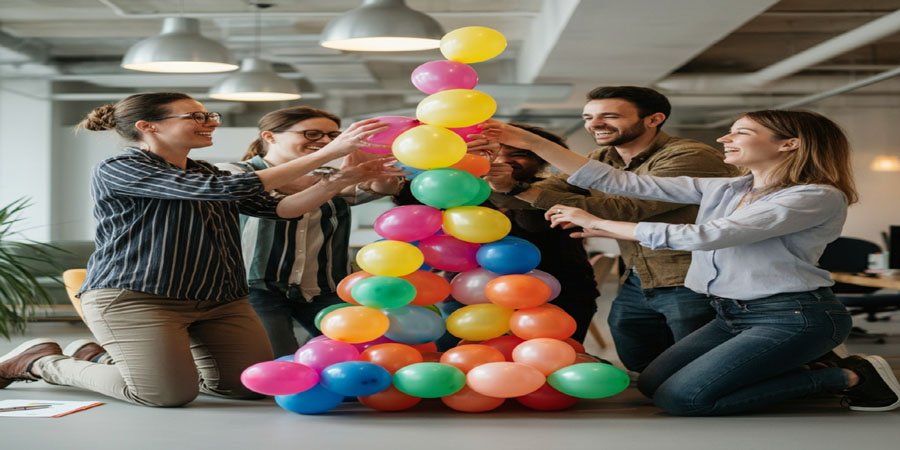
Do you want to conduct the balloon pyramid activity with your teams?
Experiential learning activities are vital for fostering collaboration, communication, and problem-solving skills. The balloon pyramid is a simple yet powerful exercise. It challenges teams to work together under constraints. This creates a memorable learning experience.
In this article, let’s see how to facilitate this activity, its variations, and the key lessons it teaches.
Here is an overview of the sections in this article:
- The primary objectives of the balloon pyramid activity.
- Five different variations of the game, including the classic version.
- Essential tips for successful facilitation.
- Frequently asked questions to address common queries.
Objective of the Activity
The balloon pyramid activity is more than just a fun game; it is a strategic exercise designed to highlight group dynamics. It reveals how teams approach challenges, manage resources, and communicate under pressure.
Here are the key objectives of the activity:
Enhancing Collaboration
The activity requires team members to coordinate their efforts closely. A single person cannot build the pyramid alone. Success depends on shared understanding, mutual support, plus collective action, making it a powerful tool for improving teamwork.
Improving Communication
Participants must communicate clearly to develop a strategy and execute it effectively. They need to discuss ideas, provide instructions, plus offer feedback. The exercise exposes gaps in communication, encouraging teams to adopt more efficient methods.
Fostering Problem-Solving Skills
Building a stable pyramid from balloons is not as easy as it sounds. Teams encounter unexpected problems, such as balloons popping or the structure collapsing. They must analyze the situation, brainstorm solutions, and adapt their approach to overcome these obstacles.
Encouraging Leadership and Role Delegation
Within each group, natural leaders may emerge to guide the process. The activity provides an opportunity for participants to practice leadership skills. It also highlights the importance of delegating tasks based on individual strengths for optimal results.
Managing Resources and Time
With limited materials and a strict time limit, teams must manage their resources wisely. They learn to prioritize tasks, make quick decisions, and work efficiently. This objective translates directly to workplace scenarios where deadlines and budgets are common constraints.
5 Variations of the Balloon Pyramid Activity
Here are 5 variations of the balloon pyramid exercise that you can try with your teams.
#1. The Classic Pyramid
This is the standard version of the activity. It serves as an excellent foundation for understanding team dynamics. The goal is straightforward: build the tallest free-standing pyramid using only balloons and tape within the given time.
Time: 10-20 minutes
Materials: 20 balloons per group, 1 roll of tape per group, and 1 measuring tape Participants: 3-8 people per group
Instructions
- Divide participants into small, equal-sized teams.
- Provide each team with their set of balloons and a roll of tape.
- Instruct them to build the tallest possible free-standing pyramid within the time limit. For instance, teams might plan a wide base for stability and then build upwards.
- At the end of the time, measure the height of each team’s pyramid to determine the winner.
Debrief
- What was the biggest challenge your team faced during the construction process?
- How did your team plan its approach before starting the build?
- If you could restart the activity, what would you do differently?
You can also read:
Customer Journey Mapping Exercise (With Debrief)
Role Play Activity (With Variations & Debrief)
Empathy Mapping Activity for Teams (With Instructions)
#2. The Silent Build
This variation adds a significant communication barrier. It forces teams to rely on non-verbal cues and intuition. The challenge reveals how well members understand each other without words.
Time: 10-20 minutes
Materials: 20 balloons per group, 1 roll of tape per group, and 1 measuring tape
Participants: 3-8 people per group
Instructions
- Set up the teams and materials just like the classic version.
- Explain that no verbal communication is allowed once the activity begins.
- Teams must use gestures, signals, and eye contact to coordinate their efforts. For example, a team member might point to a specific spot on the base to indicate where the next balloon should go.
- The team with the tallest free-standing pyramid at the end wins.
Debrief
- How did the restriction on verbal communication affect your team’s strategy?
- What non-verbal methods did your team use to communicate effectively?
- What did this exercise teach you about the importance of clear communication?
#3. The One-Handed Challenge
This version introduces a physical constraint to simulate resource limitations. It requires greater coordination and patience from all team members. The difficulty forces participants to find creative ways to assist one another.
Time: 10-20 minutes
Materials: 20 balloons per group, 1 roll of tape per group, and 1 measuring tape
Participants: 3-8 people per group
Instructions
- Ask each team to choose which hand they will not use during the activity.
- Instruct all participants to place their chosen hand behind their back for the duration of the build.
- Teams must build their pyramid using only their available hands. For instance, two people might need to work together just to apply a piece of tape.
- Measure the pyramids at the end to find the winner.
Debrief
- How did the physical limitation change your team’s approach to the task?
- In what ways did you need to depend on your teammates more than usual?
- What did this experience reveal about adapting to unforeseen constraints?
#4. The Blindfolded Architect
In this challenging variation, one person directs the team without being able to see. This setup emphasizes the need for precise instructions plus active listening. It is an excellent test of trust within a team.
Time: 10-20 minutes
Materials: 20 balloons per team, 1 roll of tape per team, 1 blindfold per team, and 1 measuring tape
Participants: 3-8 people per team
Instructions
- Each team designates one member as the “Architect.” The Architect is blindfolded and is the only person allowed to give instructions.
- The other team members, the “Builders,” cannot speak. For example, the Architect must describe exactly where to place a balloon, while the Builders must interpret these directions accurately.
- The Architect cannot touch the materials, relying solely on their verbal directions to guide the team.
- Finally, the team that builds the tallest pyramid wins.
Debrief
- For the Architects: What was the most difficult part of guiding your team without seeing?
- For the Builders: How did you ensure you understood the Architect’s instructions?
- How does this activity reflect the relationship between leaders and team members in a project?
#5. The Resource Barter
This variation adds a layer of negotiation and strategic thinking. Teams must interact with each other to acquire the necessary materials. It simulates a competitive environment where collaboration between teams can be beneficial.
Time: 15-20 minutes
Materials: A mixed collection of balloons (different sizes, shapes, etc.) and limited tape strips per team
Participants: 3-8 people per team
Instructions
- Give each team an incomplete or imbalanced set of materials. For example, one team might have many small balloons but no tape, while another has large balloons and limited tape.
- Explain that teams can trade or barter with other teams to get the resources they need.
- The primary goal is still to build the tallest pyramid, but success now also depends on negotiation skills.
- Allow a few minutes for negotiation before the building time starts.
Debrief
- How did your team decide what resources to trade for?
- What negotiation strategies worked well when dealing with other teams?
- Did your team consider collaborating with another team for a mutual benefit? If so, why?
Tips for Successful Facilitation
A well-facilitated activity ensures that participants not only have fun but also gain meaningful insights. Your role as a facilitator is crucial in creating a positive and productive learning environment.
Here are some tips to help you lead a successful balloon pyramid session:
Set a Clear and Positive Tone
Start the activity with enthusiasm. Explain the rules clearly and emphasize that the goal is about learning, not just winning. A positive atmosphere encourages participants to engage fully and take creative risks without fear of failure. Your energy will set the stage for the entire exercise.
Prepare Materials in Advance
Ensure you have all the necessary materials sorted and ready for each team before the session begins. Count the balloons, pre-cut tape strips if needed for a specific variation, and have a measuring tape on hand. Being organized prevents delays and allows the activity to run smoothly, keeping the participants’ energy and focus high.
Observe and Take Notes
While the teams are working, walk around and observe their interactions. Pay attention to their communication styles, problem-solving approaches, and how they handle setbacks. Take notes on specific behaviors or quotes that you can use as concrete examples during the debrief session. These observations will make the discussion more relevant and impactful.
Manage Time Effectively
Keep a close eye on the clock. Give teams warnings when they are halfway through their time and when they have one minute left. This helps them manage their pace and creates a sense of urgency. Sticking to the time limit ensures the activity remains dynamic and focused. It also teaches participants the importance of working efficiently under pressure.
Lead a Thorough Debrief
The debrief is the most important part of the activity. Guide the teams through a reflective discussion using open-ended questions. Encourage everyone to share their perspective. Connect their experiences during the game to real-world work situations. This is where the true learning happens, as teams translate the fun of the activity into actionable workplace improvements.
Want Some Unique Leadership Development Activities?
If you want some unique activities to equip your employees (both in-person and virtual) with leadership skills, qualities, and mindset, you can get my premium e-book:
Or Want Some Unique Team Building Activities?
If you want some unique activities for your employees (both in-person and virtual), you can get my premium e-book:
Final Words
The balloon pyramid activity is a versatile and effective tool for team development. Its simplicity allows teams to focus on the core dynamics of collaboration, communication, and problem-solving. By adapting the variations to your team’s specific needs, you can address different challenges. The real value comes from the post-activity debrief. This is where insights are shared and lessons are applied to everyday work. Ultimately, this engaging exercise helps build stronger, more cohesive teams.
FAQ: Balloon Pyramid Activity
You might have these questions in mind.
What is the ideal group size for this activity?
The ideal group size is between three and eight people. This range is small enough to ensure everyone can participate actively. It is also large enough to create complex group dynamics. If your total group is larger, simply divide them into smaller teams.
Can this activity be done outdoors?
Yes, this activity can be done outdoors. However, you should consider the weather conditions. Wind can make building a stable balloon pyramid very challenging or impossible. A calm day or a sheltered outdoor space would be best for this activity.
How can I make the activity more challenging?
To increase the challenge, you can add more constraints. For example, limit the amount of tape, introduce different balloon shapes, or require teams to build a specific design instead of a classic pyramid. Combining variations, like the Silent Build with the One-Handed Challenge, can also significantly raise the difficulty.
What if a team’s pyramid collapses?
A collapse is a valuable part of the learning experience. It forces the team to regroup, analyze what went wrong, and adapt their strategy. As a leader, encourage them to see it not as a failure but as an opportunity to demonstrate resilience and problem-solving skills under pressure.
How does this activity relate to Agile principles?
This activity mirrors several Agile principles. Teams work in short, time-boxed sprints to deliver a functional product (the pyramid). They must adapt to challenges, collaborate closely, and continuously improve their process. The debrief session is similar to an Agile retrospective, where the team reflects on what went well and what could be improved for the next iteration.