
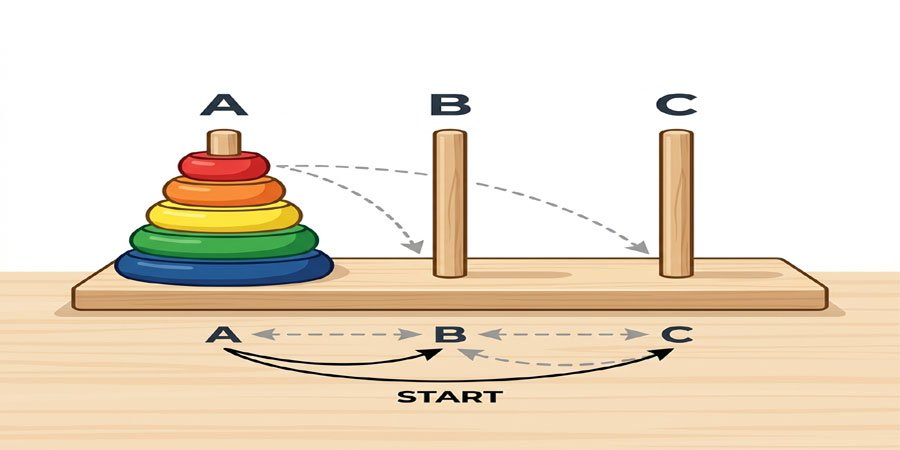
Do you want to conduct the Tower of Hanoi Game with your teams?
This activity taps into logic, sequencing, pattern recognition, and solving problems within clear rules. It gives participants a task where each move must be chosen by weighing both the current state and the final goal. Planning shapes the results, showing how big outcomes come from thoughtful steps. The exercise is great for learning, facilitation, and team reflection.
In this article, let’s see how you can conduct this activity with your teams.
Here is an overview of the sections in this article:
- Objective of the Activity
- 5 Variations of the Tower of Hanoi Game
- Tips for Successful Facilitation
- Frequently Asked Questions about the Exercise
So, let’s get started!
Objective of the Activity
The Tower of Hanoi Game goes beyond a simple puzzle because it trains participants to think carefully within set limits. People soon see that thoughtful, patient moves lead to better results than rushing.
Here are the key objectives of this activity.
Build Strategic Thinking
This exercise helps participants think several steps ahead before making a move. Instead of acting on impulse, they need to picture the result of each action. That process builds strategic thinking in a practical way. Over time, people begin to see how one small choice can shape the whole outcome. This makes the activity a strong fit for sessions on planning or decision making.
Strengthen Problem-Solving Skills
The puzzle gives a clear goal, though the path is not always obvious. Participants must test ideas, notice mistakes, and adjust their approach as they go. This encourages flexible problem solving rather than fixed thinking. It also shows that difficult tasks become easier when broken into smaller parts. That lesson transfers well to workplace challenges.
Improve Focus and Attention
The rules are simple, yet each move matters. A small error can slow progress, so participants must stay alert during the task. This helps improve concentration, especially when the room is active or time is limited. The activity rewards careful observation, not speed alone. As a result, people learn the value of attention in high-pressure moments.
Encourage Patience and Discipline
Many participants want to rush toward the answer. The Tower of Hanoi teaches that progress often depends on discipline rather than haste. Players must follow rules, resist random moves, and accept that some progress feels slow at first. This creates a useful lesson about patience. In many team settings, that mindset can support better collaboration and stronger outcomes.
Reveal Systems Thinking
At first, the puzzle can look like a series of separate moves. After a few attempts, participants begin to understand that every move belongs to a larger system. They start noticing patterns, dependencies, and sequences that repeat. This helps them see how complex tasks often become manageable through structure. For facilitators, this makes the exercise a smart way to introduce systems thinking without heavy theory.
5 Variations of the Tower of Hanoi Game
Here are 5 variations of the Tower of Hanoi Game for your teams.
#1. Classic Tower Of Hanoi
This is the standard version where participants move all disks from one peg to another while following the core rules. It is the best choice when you want people to learn the basic logic before trying harder formats.
Time: 10-20 minutes
Materials: Three Pegs and Three To Six Disks
Participants: 3-8 people per group
Instructions
- Place all disks on the first peg in size order, with the largest at the bottom and the smallest on top.
- Explain the puzzle rules clearly: Move only one disk at a time, and always take from the top of any stack. No disk may be placed on a smaller disk. You must move the full stack to the third peg by following these rules for every move.
- Ask the team to move the full stack to the last peg in the fewest moves possible. For example, with three disks, they can test the pattern before trying more.
- After the round, review the move sequence so participants can spot the logic behind the solution.
Debrief
- What did you notice about the value of planning before the first move?
- When did the pattern begin to make sense for you?
- How can this exercise relate to solving real work problems?
Solution Explanation:
Solving the Classic Tower of Hanoi becomes easier when you label the pegs as A (start), B (helper), and C (destination). For three disks, begin with all disks on peg A. Follow these steps:
- Move Disk 1 from A to C.
- Move Disk 2 from A to B.
- Move Disk 1 from C to B.
- Move Disk 3 from A to C.
- Move Disk 1 from B to A.
- Move Disk 2 from B to C.
- Move Disk 1 from A to C.
Repeat this sequence using the same idea when you add more disks. Always move the smaller stack to the helper peg (B), move the biggest disk to the destination (C), then rebuild the stack on top. The minimum number of moves is always 2^n – 1 (where n is the number of disks).
You can also read:
50 Easy Team Building Activities (Workplace)
#2. Silent Strategy Version
In this variation, participants complete the puzzle without speaking during the active round. This adds pressure because people must rely on observation, turn-taking, and nonverbal coordination.
Time: 10-20 minutes
Materials: Three Pegs and Three To Five Disks
Participants: 3-8 people per group
Instructions
- Set up the puzzle in the standard format, then explain the usual rules before the round begins.
- Tell the team that no one may speak once the first move starts.
- Ask players to decide who moves next through eye contact or gestures. For instance, one person may step back to signal another player.
- End the round with a short review of how silence changed their approach to coordination.
Debrief
- How did silence affect your decision making?
- What helped you coordinate without spoken input?
- Where do you see value in nonverbal awareness at work?
#3. Timed Challenge Version
This version keeps the original rules but adds a countdown to increase urgency. It helps participants practice calm thinking when time pressure enters the task.
Time: 10-20 minutes
Materials: Three Pegs, Three To Six Disks, and A Timer
Participants: 3-8 people per group
Instructions
- Introduce the puzzle with the normal setup, then give participants a clear time limit.
- Tell the group to finish the transfer before time runs out while still following every rule.
- Encourage them to pause briefly to plan instead of rushing into random moves. For example, a thirty-second planning period can improve results.
- Compare outcomes after the round by discussing whether speed helped or hurt accuracy.
Debrief
- How did the time limit change your behavior?
- Did planning feel harder or more important under pressure? If so, why?
- What does this show about speed versus quality in daily tasks?
#4. Reverse Start Version
In this format, participants begin with the disks on the third peg and must move them to the first peg. The puzzle logic stays the same, yet the switch in direction helps people view the task from a fresh angle.
Time: 10-20 minutes
Materials: Three Pegs and Three To Six Disks
Participants: 3-8 people per group
Instructions
- Set the full stack on the third peg instead of the first peg before the activity begins.
- Explain that all regular rules still apply even though the destination has changed.
- Ask the group to complete the puzzle while paying attention to whether the new direction changes their mental model. For instance, some players may find the pattern easier to track this way.
- Debrief the round by comparing it with the classic version if participants have tried both.
Debrief
- Did changing the starting point affect your confidence? If so, why?
- What stayed the same even though the setup changed?
- How can reframing a problem help in real situations?
#5. Rotating Leader Version
This variation gives one participant temporary leadership for a few moves before passing control to another person. It adds an extra layer of communication, ownership, and shared responsibility.
Time: 10-20 minutes
Materials: Three Pegs, Three To Five Disks, and A Move Counter
Participants: 3-8 people per group
Instructions
- Begin with the standard setup, then assign one player as the leader for the first two or three moves.
- Tell the team that only the current leader may decide the next move sequence during their turn.
- Rotate leadership at set intervals so several people guide the activity. For example, each player may lead after every two moves.
- Discuss how leadership changes affected progress, clarity, and trust during the challenge.
Debrief
- What was easy or hard about leading the activity for a short time?
- How did leadership changes shape the flow of the task?
- What does this reveal about shared ownership in team work?
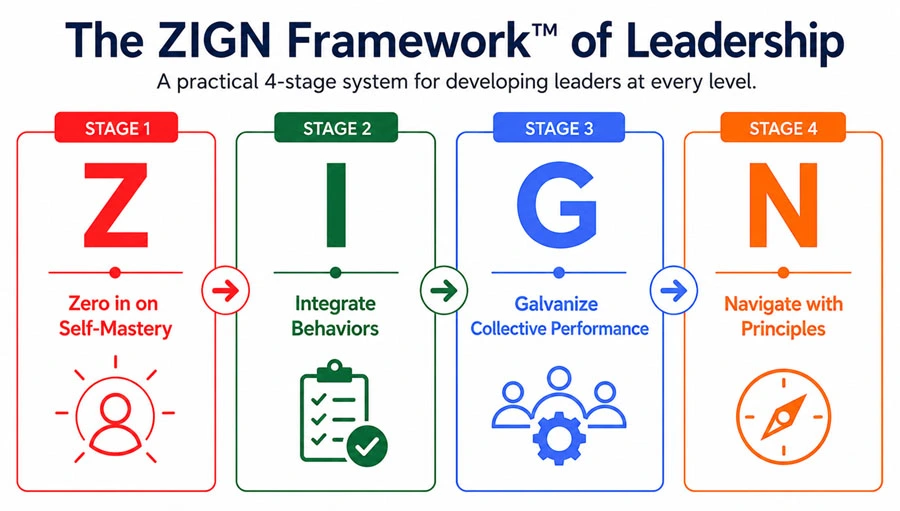
Want to Develop Leaders at Every Level of Your Organization?
If you want a practical system to develop leaders at all levels, get this master guide and apply our proprietary ZIGN Framework™ of Leadership:
Or Looking for Unique Team Building Activities?
If you want unique activities that help your workforce grow through every stage of team development, get this guide:
Tips for Successful Facilitation
A well-run Tower of Hanoi session depends on more than the puzzle itself. The way you introduce, guide, and review the activity often shapes the learning value.
The tips below can help you create a smoother experience for participants.
Explain the Rules with Care
Start with a clean explanation of the rules before anyone touches the disks. Keep the wording simple: one disk at a time, only the top disk can move, and no larger disk may sit on a smaller one. If needed, show one legal move and one illegal move. This prevents confusion later. A clear start saves time and supports fairness.
Choose the Right Difficulty
The number of disks changes the challenge level a lot. Three disks work well for beginners because people can learn the pattern quickly. Four or five disks create more thought and discussion without making the task too long. If you use six disks, be sure your participants are ready for a harder round. Match the setup to the time available and the confidence level in the room.
Let Participants Think Before Acting
Many people want to begin at once. Give them a short planning window before the first move so they can discuss ideas or observe the setup. This small pause often leads to better performance and richer reflection. It also highlights a key lesson: thoughtful preparation can reduce wasted effort. In facilitation, that lesson matters as much as the puzzle result.
Focus on Reflection, Not Only Completion
Some participants will solve the puzzle, while others may not finish in time. Both outcomes can create strong learning if you debrief well. Ask what strategies worked, what caused setbacks, and how they adapted. Draw links to planning, process design, communication, or patience. The exercise becomes more meaningful when people connect it to real situations.
Manage the Energy in the Room
Keep the pace active without creating stress that blocks learning. Encourage participants when they get stuck, though avoid giving the full answer too soon. If frustration rises, remind them that the activity is about process, not perfection. You can also reduce the number of disks for a reset if needed. A balanced tone helps people stay engaged and open to insight.
Final Words
The Tower of Hanoi Game is a simple activity with deep learning value. It helps participants practice logic, focus, patience, and structured problem solving. With the right variation, it can fit many team sessions in a short amount of time. As a facilitator, your guidance and debrief will shape how much people learn from the experience. Use the puzzle with care, and it can become a memorable exercise for your teams.
FAQ: Tower of Hanoi Game
You might have these questions in mind.
What is the main goal of the Tower of Hanoi Game?
The main goal is to move the full stack of disks from one peg to another while following the rules. Participants must do this by moving only one disk at a time. They also cannot place a larger disk on top of a smaller one. The challenge is to complete the task through logic rather than guesswork.
How many disks should beginners use?
Beginners usually do best with three disks. This version is simple enough to understand, yet it still shows the core pattern clearly. Once participants solve it, you can increase the number to four or five for a stronger challenge. That step-by-step approach builds confidence.
Why is this activity useful for teams?
This exercise helps people practice planning before action. It also supports focus, patience, and shared problem solving during a short session. When used in a team setting, the puzzle can reveal how people respond to limits, pressure, and mistakes. Those insights often connect well to workplace tasks.
Is there a formula for the minimum number of moves?
Yes, there is a simple formula: 2^n – 1, where n is the number of disks. That means three disks need seven moves, while four disks need fifteen. This formula helps facilitators explain why the puzzle grows harder so quickly. It also adds a useful math connection to the activity.
Can I use this activity in training sessions?
Yes, this puzzle works well in training, workshops, classrooms, and leadership sessions. It is short, low-cost, and easy to set up with simple materials. You can use it to explore topics like strategy, communication, sequencing, or process improvement. The key is to connect the debrief to the learning goal of your session.
Like this article on the “Tower of Hanoi Game”? Feel free to share your thoughts.
