
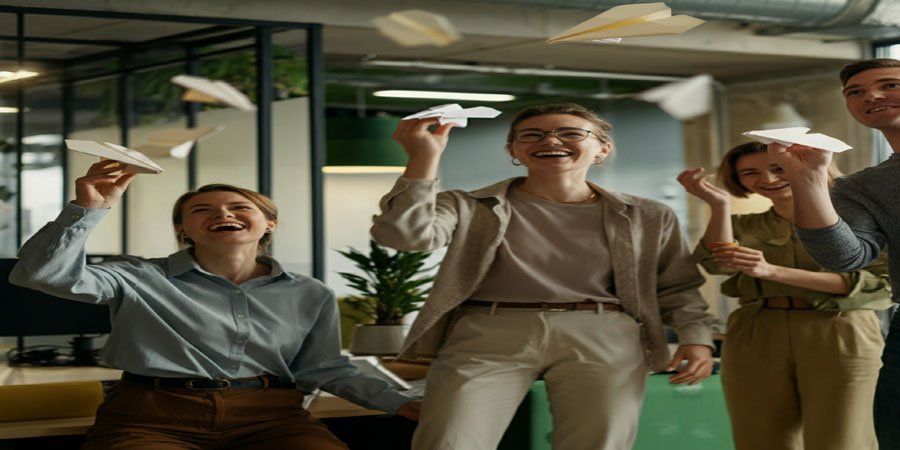
Do you want to conduct the paper plane challenge with your teams?
The paper plane game is a classic team building exercise rooted in principles of iterative design and process improvement. It mirrors real-world projects where teams must plan, execute, evaluate, and refine their approach to achieve a common goal. This activity provides a simple, tangible way to observe team dynamics, communication patterns, and problem-solving skills in action.
In this article, let’s see how you can run this engaging activity with your teams.
Here is an overview of the sections in this article:
- The primary objectives of running the paper plane challenge.
- Five different variations of the activity, including the classic version.
- Practical tips to ensure the activity runs smoothly.
- Frequently asked questions about the activity.
Objective of the Activity
The paper plane challenge offers more than just a fun break from the usual work routine; it is a powerful experiential learning tool. It reveals how teams function under pressure while working toward a specific, measurable outcome.
Here are the key objectives of this activity:
Enhancing Communication
Effective communication is the cornerstone of this activity. Teams must discuss design ideas, delegate tasks, and provide constructive feedback. Participants learn to articulate their thoughts clearly, listen actively to others’ suggestions, and reach a consensus on the best path forward. This process highlights the importance of open dialogue for successful project execution.
Fostering Collaboration
The challenge requires individuals to pool their knowledge and skills to achieve a shared objective. It breaks down silos and encourages a “we are in this together” mentality. Participants realize that their collective success depends on their ability to work cohesively, support each other, and leverage the unique strengths of each team member. This builds a foundation for stronger teamwork.
Promoting Problem-Solving
Faced with the task of creating a high-performing paper plane, teams must identify potential problems and brainstorm creative solutions. This involves analyzing design flaws, testing different folding techniques, and adapting their strategy based on performance results. The activity sharpens critical thinking and encourages an innovative approach to overcoming obstacles, which are essential skills for any workplace.
Understanding Iterative Improvement
The activity is a practical lesson in continuous improvement, a core concept in methodologies like Agile. Teams build a prototype, test it, gather data from the flight, and use that information to refine their design. This cycle of building, testing, and learning demonstrates that the first attempt is rarely perfect. Success comes from making small, incremental changes based on feedback and results.
Observing Team Dynamics
For facilitators, the challenge provides a clear window into team dynamics. It allows you to observe leadership styles, decision-making processes, and how the group handles success or failure. You can see who takes charge, who contributes creative ideas, and how conflicts are resolved. These insights are invaluable for understanding your team’s strengths and areas for development.
5 Variations of the Paper Plane Challenge
Here are 5 variations of the paper plane challenge that you can use to energize your team meetings.
#1. The Classic Distance Challenge
This is the standard version of the activity, where the goal is straightforward and clear. Each team’s objective is to design and build a paper plane that can fly the farthest possible distance.
Time: 10-20 minutes
Materials: A4 or letter-sized paper, measuring tape, and markers to identify planes
Participants: 3-8 people per group
Instructions
- Ask each team to use the provided paper to design and construct one paper airplane. The primary goal is to maximize the flight distance.
- Give the teams a set amount of time, for instance 5 minutes, for the design and construction phase.
- After the construction phase, have each team launch its plane one at a time from a designated starting line. The facilitator will measure and record the distance for each flight.
- Allow for a second round where teams can briefly modify their designs based on the first flight’s performance before a final launch.
Debrief
- What was the most challenging part of designing a plane for maximum distance?
- How did your team decide on the final design?
- If you had more time, what other changes would you make to your plane?
You can also read:
Two Truths and a Lie Game (With Variations & Debrief)
Marshmallow Challenge for Teams (With Instructions)
#2. The Accuracy Challenge
This variation shifts the focus from distance to precision and control. The goal here is for teams to design a plane that can land as close as possible to a designated target.
Time: 10-20 minutes
Materials: A4 or letter-sized paper, a target (e.g., a hoop or a marked circle), and measuring tape
Participants: 3-8 people per group
Instructions
- Explain that the objective is to land the paper plane inside or as close as possible to a target placed a certain distance away.
- Provide teams with time to build a plane they believe will have a stable and accurate flight path.
- Have each team throw its plane toward the target. For example, if a plane lands 5 inches from the target, its score is 5.
- Measure the distance from where each plane lands to the center of the target. The team with the lowest score wins.
Debrief
- How did designing for accuracy differ from designing for distance?
- What strategies did your team use to try and control the plane’s flight?
- How did you adapt your throwing technique to improve your aim?
#3. The Airtime Challenge
In this version, the focus is on maximizing the duration of the flight. Teams must engineer a plane that can stay in the air for the longest possible time.
Time: 10-20 minutes
Materials: A4 or letter-sized paper, and stopwatches
Participants: 3-8 people per group
Instructions
- Instruct each team to build a paper plane designed for maximum “hang time” or flight duration.
- Have teams launch their planes one by one in an open area, preferably indoors with high ceilings to avoid wind interference.
- Use stopwatches to time how long each plane remains airborne from the moment of launch until it touches the ground. For instance, a flight lasting 4.5 seconds gets that score.
- The team whose plane stays in the air for the longest duration wins the challenge.
Debrief
- What design features did your team focus on to increase airtime?
- How did your team test different ideas for slowing the plane’s descent?
- What role did the launch technique play in the duration of the flight?
#4. The Mass Production Challenge
This variation introduces elements of a supply chain and division of labor. The goal is to produce the highest number of functional paper planes within a strict time limit.
Time: You decide
Materials: A large stack of A4 or letter-sized paper, and markers
Participants: 3-8 people per group
Instructions
- Challenge teams to create an assembly line to produce as many identical, functional paper planes as possible in a short time frame, like 5 minutes.
- Explain that at the end of the time, each plane will be tested with a short flight to ensure it is “functional.”
- Teams must organize themselves, with some members folding specific parts and others assembling the final product. For example, one person might do the first two folds, then pass it to the next person for the next folds.
- Count the number of planes from each team that successfully fly at least a short distance. The team with the most functional planes wins.
Debrief
- How did your team organize the production process to be efficient?
- What bottlenecks or issues did you encounter in your assembly line?
- Did the quality of the planes suffer as you tried to increase quantity? If so, why?
#5. The Payload Challenge
This challenge adds a layer of engineering complexity by requiring the plane to carry cargo. Teams must balance aerodynamics with the need to transport a small weight.
Time: 10-20 minutes
Materials: A4 or letter-sized paper, paper clips or small coins as payload, and measuring tape
Participants: 3-8 people per group
Instructions
- Ask each team to design a paper plane capable of carrying a standard payload, such as a paper clip or a small coin.
- The objective is for the plane to fly the farthest distance while successfully carrying its cargo.
- Teams must figure out how to attach the payload without compromising the plane’s stability and flight performance. For instance, they might create a small pocket or use the paper clip to hold folds together.
- Measure the distance of each successful flight. The team whose plane flies the farthest with the payload wins.
Debrief
- How did adding a payload affect your initial plane design?
- What was the biggest challenge in balancing the plane with the extra weight?
- What did this exercise teach you about adapting a design for new requirements?
Want to Develop Leaders at Every Level of Your Organization?
If you want a practical system to develop leaders at all levels, get this master guide and apply our proprietary ZIGN Framework™ of Leadership:
Looking for Unique Team Building Activities?
If you want unique activities that help your workforce grow through every stage of team development, get this guide:
Or Want New Team Building Activities Every Month?
Tips for Successful Facilitation
A well-facilitated activity ensures that participants not only have fun but also gain meaningful insights. Your role as a facilitator is to create a positive environment and guide the learning process.
Here are some tips to help you run a successful paper plane challenge.
Set Clear Expectations
Before the activity begins, clearly explain the rules, objectives, and time limits for the specific variation you have chosen. Ensure everyone understands what defines success, whether it is distance, accuracy, or another metric. A clear framework prevents confusion and allows teams to focus their energy on the task. Being upfront about the constraints helps manage expectations and keeps the activity on track.
Encourage a Safe Environment
Create a psychologically safe space where participants feel comfortable sharing ideas, taking risks, and even failing. Emphasize that the goal is not to produce a perfect plane on the first try but to learn through experimentation. Remind teams that creative or unconventional ideas are welcome. This supportive atmosphere encourages participation from all team members, not just the most assertive ones.
Manage the Time Effectively
Keep a close eye on the clock and provide time warnings as the construction phase nears its end. Sticking to the schedule maintains the activity’s energy and introduces a realistic sense of pressure. If you see teams struggling, you can offer a brief time extension, but be consistent for all groups. Effective time management ensures the activity flows smoothly from the building phase to the launch and debrief.
Observe Without Intervening
During the construction phase, your primary role is to be an observer. Pay attention to how teams communicate, delegate tasks, and solve problems. Resist the urge to jump in with suggestions or solutions, even if a team is struggling. These moments of struggle are often where the most valuable learning occurs. Your observations will be crucial for guiding the debrief session later.
Lead a Meaningful Debrief
The debrief is the most critical part of the activity. This is where you connect the fun of building paper planes to real-world work challenges. Use open-ended questions to guide the discussion. Ask teams to reflect on their process, what worked well, and what they could have done differently. Focus the conversation on topics like communication, collaboration, and iterative improvement to help participants draw valuable conclusions.
Final Words
The paper plane challenge is a simple, effective, and memorable team building activity. It uses a familiar object to teach complex lessons about teamwork, communication, and innovation. The activity demonstrates the power of collaboration and the importance of an iterative process. By planning, executing, and refining, teams can achieve remarkable results. Ultimately, it provides a shared experience that strengthens bonds and fosters a more collaborative spirit within the team.
FAQ: Paper Plane Challenge
You might have these questions in mind.
How long does the activity usually take?
The entire activity, including the introduction, construction, launch, and debrief, can typically be completed in 10 to 20 minutes. The construction phase itself is usually short, around 5 minutes, to encourage quick thinking and collaboration under a time constraint. The flexibility of the activity allows you to adjust the timing to fit your meeting schedule.
Can this exercise be done with remote teams?
Yes, the paper plane challenge can be adapted for virtual teams. Each participant can build their own plane at home, and the team can collaborate via video conference to agree on a single design. For the launch, participants can record their flights and share the videos, or a designated “thrower” can build the team’s final design and test it on their behalf.
What is the ideal group size for this activity?
The activity works best with small groups of 3 to 8 people. This size is large enough to encourage diverse ideas but small enough to ensure everyone can participate actively in the discussion and construction process. If you have a larger group, you can split them into multiple smaller teams that compete against each other.
What is the most important part of this challenge?
While the building and flying part is fun, the most important part is the debrief session. This is where the learning happens. The debrief connects the experience of the activity to real-world work scenarios, allowing participants to reflect on their team’s communication, problem-solving, and collaboration skills.
How do I choose the right variation for my team?
Consider your team’s current goals. If you want to focus on process efficiency, the “Mass Production” variation is a great choice. If innovation and adapting to new constraints are key, try the “Payload Challenge.” The “Classic Distance Challenge” is an excellent all-around option for focusing on general collaboration and problem-solving.
Like this article on the “Paper Plane Challenge for Teams”? Feel free to share your thoughts.
