
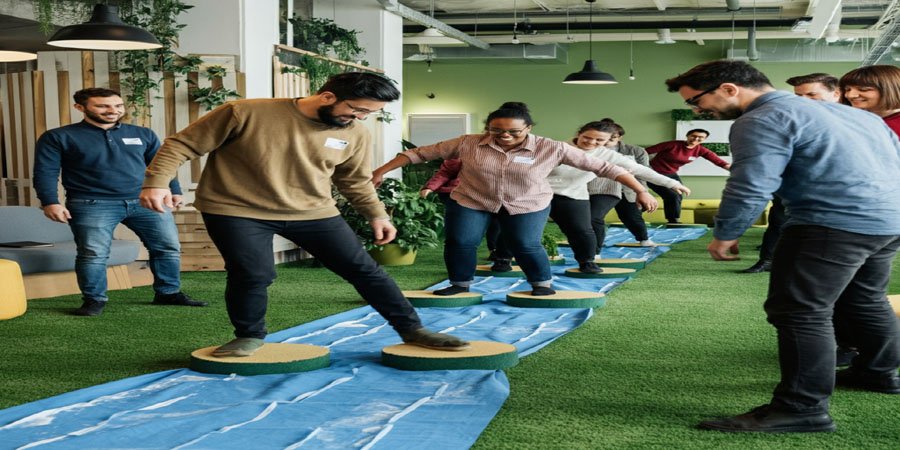
Do you want to conduct the crossing the river activity with your teams?
Experiential learning activities move beyond theory, allowing teams to practice skills in a simulated environment. The “Crossing the River” game is a classic problem-solving challenge that highlights communication, planning, and collaboration. It creates a memorable experience where participants can discover their strengths and areas for improvement in a low-stakes setting. By engaging in this hands-on exercise, teams can build trust and develop more effective strategies for real-world challenges.
In this article, let’s see how to facilitate this impactful activity with your teams, including several variations and tips.
Here is an overview of the sections in this article:
- Objective of the Crossing the River Activity
- 5 Variations of the activity, including the classic version
- Tips for successful facilitation
- Frequently asked questions about the activity
Objective of the Activity
The Crossing the River activity is designed to be more than just a fun break from the usual routine. It is a strategic exercise with specific developmental goals for any team.
Let’s explore the key objectives this activity aims to achieve.
Foster Teamwork
The activity emphasizes the importance of collaboration by requiring participants to work cohesively to achieve a common goal. Team members must communicate effectively, share ideas, and support one another to succeed. This highlights the value of collective effort over individual actions.
Enhance Problem-Solving Skills
Participants are presented with a challenge that demands creative and strategic thinking. They must evaluate their resources, identify potential solutions, and quickly adapt to changes. This sharpens their ability to analyze situations and implement effective strategies under pressure.
Improve Communication
Clear and open communication is essential as participants discuss strategies and provide input. The activity fosters an environment where everyone has to listen, voice perspectives, and clarify intentions to avoid misunderstandings. This practice strengthens overall communication skills within the team.
Build Trust and Dependability
Each team member plays a crucial role in the group’s success, relying on one another to achieve the task. The activity builds trust by reinforcing the idea that everyone contributes value. It also encourages dependability, as individuals learn to fulfill their responsibilities for the collective outcome.
Develop Leadership Skills
The challenge creates opportunities for individuals to step up and take on leadership roles. Leaders emerge organically as team members identify the need for coordination and direction. This helps participants grow in confidence, decision-making, and guiding others effectively.
5 Variations of Crossing the River
Here are 5 variations of the Crossing the River activity that you can adapt for your team’s specific needs.
#1. The Classic River Crossing
This is the standard version of the activity, perfect for introducing the core concepts of planning and collaboration. The team receives a set of “stones” to create a path across a designated “river.”
Time: 10-20 minutes
Materials: 8-10 placemats or pieces of paper (the “stones”)
Participants: 3-8 people per group
Instructions
- Define a starting line and a finish line to represent the two riverbanks. Ask each team to stand behind the starting line.
- Give the teams their set of “stones.” Explain that they can only step on the stones; touching the “water” (the floor) means the person and the stone they last touched are sent back to the start.
- Teams must work together to place their stones strategically, creating a path across the “river” without leaving anyone behind. They must retrieve and reuse stones as they progress.
- The first team to get all members across the finish line without anyone touching the “water” is declared the winner.
Debrief
- What was your initial plan, and how did it change once you started?
- How did the team handle disagreements or different ideas for the solution?
- What moments showed strong teamwork, and what moments could have been improved?
You can also read:
Build a Bridge Activity for Teams (With Instructions)
#2. The Mute River
This variation adds a significant communication barrier, forcing the team to rely on non-verbal cues and trust. It emphasizes the importance of clear gestures and shared understanding.
Time: 10-20 minutes
Materials: 8-10 placemats or pieces of paper
Participants: 3-8 people per group
Instructions
- Set up the riverbanks and stones just like the classic version.
- Instruct the team that no verbal communication is allowed once the activity begins. Talking, whispering, or mouthing words will result in a penalty, such as losing a stone or sending a player back.
- Explain that they must rely entirely on gestures, pointing, and other non-verbal signals to coordinate their crossing. For example, a team might develop a hand signal for “pass me a stone.”
- The goal remains the same: get the entire team across the river without anyone touching the water.
Debrief
- How did the inability to speak change your team’s approach to problem-solving?
- What new challenges or frustrations emerged, and how did you overcome them?
- Which non-verbal communication methods were most effective, and why?
#3. The Treasure Hunt River
This version introduces an additional objective, requiring the team to manage multiple priorities simultaneously. The team must not only cross the river but also retrieve specific items along the way.
Time: 15-20 minutes
Materials: 6-8 placemats or paper, and 3-4 small objects (the “treasure”) like beanbags or balls
Participants: 3-8 people per group
Instructions
- Place the “treasure” objects at various points within the river area.
- Inform the team that they must collect all the treasure items before the last person reaches the finish line.
- Establish that only a person standing on a stone can pick up a treasure. For instance, they cannot reach from the riverbank to grab a nearby object.
- The team successfully completes the challenge only after all members and all treasure items are safely across the river.
Debrief
- How did the extra goal of collecting treasure affect your initial strategy?
- Who took charge of planning the route to collect the items?
- Did you ever have to choose between moving a person forward or retrieving an item? If so, why?
#4. The Shrinking River
In this challenging variation, the team’s resources diminish over time, forcing them to become more efficient and creative. It simulates projects where resources become scarcer as deadlines approach.
Time: 10-15 minutes
Materials: 10-12 placemats or pieces of paper
Participants: 4-8 people per group
Instructions
- Explain the standard rules for crossing the river.
- Announce that every 90 seconds, you will remove one of the stones that is not currently being stood on. If all stones are occupied, you will wait until one is free.
- This rule creates urgency and forces the team to keep moving and use their stones wisely. For example, leaving a stone behind for too long means it will be lost.
- The team must get everyone across before they run out of stones to form a viable path.
Debrief
- How did the pressure of losing your resources impact your team’s decision-making?
- What emotions did you feel as the stones started disappearing?
- If you were to do it again, what would you do differently to be more efficient?
#5. The Blindfolded Guide
This variation focuses on trust and precise communication, as most of the team is unable to see. One or two members must guide the rest of the group using only verbal instructions.
Time: 15-20 minutes
Materials: 8-10 placemats/pieces of paper, and blindfolds for most of the team
Participants: 4-8 people per group
Instructions
- Ask the team to choose one or two members to be the “guides.” The rest of the team will be blindfolded.
- Explain that only the guides can see, but they are not allowed to enter the river or touch any stones. They must direct their blindfolded teammates from the starting bank.
- The blindfolded members must rely entirely on the guides’ verbal commands to place stones and move across. For example, a guide might say, “Take two steps forward and place the stone directly in front of your left foot.”
- The challenge is complete when all blindfolded members have safely crossed the river.
Debrief
- For the guides: what was the hardest part about giving clear, precise instructions?
- For the blindfolded members: how did it feel to place your trust completely in your teammates’ directions?
- How did the team ensure that the instructions were understood correctly before anyone made a move?
Want to Develop Leaders at Every Level of Your Organization?
If you want a practical system to develop leaders at all levels, get this master guide and apply our proprietary ZIGN Framework™ of Leadership:
Looking for Unique Team Building Activities?
If you want unique activities that help your workforce grow through every stage of team development, get this guide:
Need Fresh Team Building Activities Every Month?
If you are a busy leader, get 5 unique, fully customizable activities every month—no preparation or trainer required.
Tips for Successful Facilitation
Facilitating the Crossing the River activity effectively is key to ensuring your team gains valuable insights. A well-run session can transform a simple game into a powerful learning experience.
Here are some tips to help you lead the activity successfully.
Set Clear Ground Rules
Before starting the activity, outline the rules clearly to ensure all participants understand the objectives and limitations. This avoids confusion and helps maintain focus during the exercise. Reinforce that the activity is about teamwork, communication, and mutual support, rather than speed or competition.
Establish Roles and Responsibilities
Assign clear roles, such as designating a few participants as leaders or communicators, to provide structure to the process. Defined roles help each member stay engaged and know how they contribute to the team’s success. This approach can also highlight the importance of leadership and delegation in achieving goals.
Encourage Open Communication
Promote an environment where team members feel comfortable voicing ideas, asking questions, or seeking clarification. Open communication helps minimize misunderstandings and ensures everyone is working towards the same objective. Include moments for debriefing and clarifying instructions during the activity.
Observe and Provide Constructive Feedback
As the facilitator, monitor interactions closely to identify strengths and areas for improvement. Provide constructive feedback after the activity, focusing on what went well and where the team can evolve. Highlight specific examples to make your feedback relatable and actionable.
Reflect and Debrief as a Group
End the activity with a group discussion to reflect on lessons learned and team dynamics. Ask participants to share their experiences, focusing on what strategies worked and what could be improved. This debriefing process ensures that the insights gained during the activity are anchored and applicable to real-life team scenarios.
Final Words
The Crossing the River activity is a versatile and effective tool for team development. It offers a practical way to observe and improve critical skills like communication, planning, and teamwork. By engaging in this challenge, teams build trust and learn to navigate problems together. The real value comes from the post-activity discussion, where experiences are translated into actionable workplace strategies. Ultimately, this simple game provides a powerful metaphor for overcoming challenges as a unified group.
FAQ: Crossing the River Activity
You might have these questions in mind.
What is the main point of this activity?
The main point is to improve teamwork through a hands-on problem-solving challenge. It highlights a team’s ability to communicate, plan a strategy, and execute it under pressure. The exercise reveals group dynamics in a low-stakes environment.
Can this activity be done virtually?
Yes, it can be adapted for virtual teams using online whiteboarding tools. Team members can move digital shapes or sticky notes across a designated “river” on a shared screen. The core challenges of communication and planning remain the same.
What if a team gets stuck and cannot solve it?
If a team is truly stuck, let them struggle for a bit, as this is part of the learning process. If they are becoming overly frustrated, you can pause the activity and allow them a two-minute “strategy huddle.” Avoid giving them the solution directly. This encourages creative problem-solving and reinforces the value of teamwork under pressure.
How can I connect this to our actual work?
During the debrief, ask questions that bridge the game and the workplace. For example: “How does the way we communicated in this game compare to how we communicate in project meetings?” This helps the team draw direct parallels and identify areas for improvement. Also, encourage team members to share specific examples of how the skills practiced during the activity can be applied to ongoing projects or challenges.
Is this activity suitable for senior leaders?
Absolutely. The activity is effective for all levels because it reveals fundamental team behaviors. For senior leaders, it can provide insights into their strategic thinking, communication style, and how they empower others in a group setting. You can use a more complex variation to challenge them appropriately.
Like this article on the “Crossing the River Activity for Teams”? Feel free to share your thoughts.
